
Summary
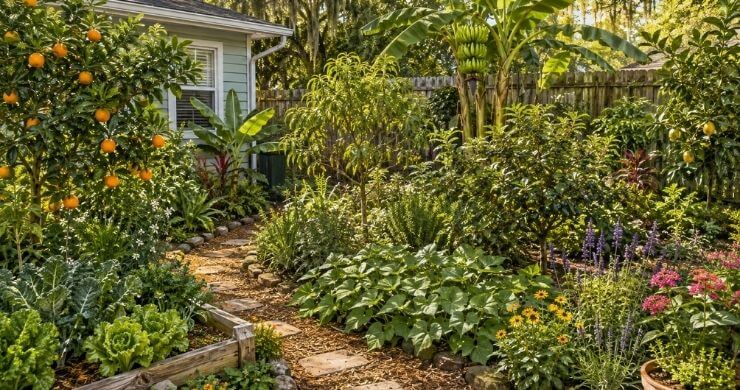
A small backyard food forest is a compact, layered edible garden that copies a natural woodland. Even a suburban yard, side lot, or patio corner can host one. This guide covers what it is, how to plan one, plants for warm climates, and beginner planting steps.
Space is often the first excuse people give for not starting a food garden. Yet a small backyard food forest can fit into a suburban lot, a narrow side yard, or even a sunny patio corner. Instead of a single-crop vegetable bed, this style of gardening layers edible trees, shrubs, herbs, and ground covers so the whole space works as one edible ecosystem.
Modern food forests trace their roots to Indigenous growing traditions and now show up across cities and suburbs as a way to grow more food from less land. Any yard can join in, but the process starts with a few basics on layout, plant choice, and setup.
What a Small Backyard Food Forest Actually Is
A food forest is a garden designed to copy a natural woodland. Instead of neat rows of a single crop, plants of different heights are layered together so each contributes something to the whole system. University of Minnesota Extension describes food forests as multi-story cropping systems that pair perennial plants with annuals for steady food production.
The layered approach usually includes three to seven layers. The overstory holds larger food-producing trees, the understory holds smaller trees and shrubs, and the floor holds herbaceous plants, root crops, ground covers, and vines. Stacking layers in the same footprint lets a small yard grow more edible plants than a single-layer bed could. Even a suburban corner can support several layers at once, which is what makes food forests useful in tight spaces.
The result feels closer to a living ecosystem than a traditional vegetable patch. UF/IFAS Extension defines a food forest as a diverse planting of edibles that imitates natural ecosystems. The USDA Forest Service points to food forests as a way to reduce urban heat, expand wildlife habitat, and improve local food security in city and suburban settings. This wider impact adds value beyond the fresh food a small backyard food forest brings home.
How to Design a Food Forest for a Small Yard
Design work matters more than plant shopping in the beginning. UF/IFAS Extension recommends the right plant, right place approach, which starts with observing the yard's sunlight, soil drainage, and water access. Most fruiting plants need partial to full sun, so a shaded corner is not the spot for a peach tree.
Size does not have to be intimidating. A 100 to 300 square foot area is plenty for a beginner, and even a single yard corner can hold a productive layered design. A small footprint also makes soil prep, mulching, and watering easier.
Choosing the right trees keeps a small space from turning into a jungle. UF/IFAS Extension suggests spacing plants by mature size, not nursery size, and keeping small-to-medium trees at least 15 feet from building foundations. Dwarf or semi-dwarf fruit varieties fit tight yards without overcrowding.
Raised beds can carry the herbaceous and root layers when native soil is poor. My quick soil calculator makes it easy to figure out how much soil mix a new bed will need. A rough sketch of the yard, with sun exposure marked, is enough of a plan to begin.
Plants that Thrive in a Small Food Forest in Warm Climates
Plant selection depends on climate more than anything else. The USDA Plant Hardiness Zone Map is the starting point, and Northeast Florida sits in Zones 9A and 9B, where average winter lows fall between 20°F and 30°F. Warm, humid climates like this support a broader plant list than most of the country.
For the canopy layer, UF/IFAS Extension recommends loquat as one of the best-adapted fruit trees for north-central Florida because it handles cold, drought, and low pruning needs. Japanese persimmon works well as a small deciduous tree, and dwarf everbearing mulberry stays around 15 feet tall for tighter yards.
The understory and shrub layer can hold rabbiteye blueberry cultivars, which handle Florida's climate when at least two varieties are planted for cross-pollination. Pineapple guava, especially dwarf cultivars, adds an evergreen edible option that stays around three to four feet tall.
The ground layers offer flexibility. Sweet potato, Malabar spinach, and roselle handle Florida summer heat, while rosemary, chives, and holy basil fit sunnier gaps. Ginger and turmeric thrive in the shade beneath larger trees, and muscadine grape, a native vine, grows well on a fence or trellis. For a broader plant list, more gardening tips cover seasonal timing and cultivars for warm climates.
First Steps to Start a Small Backyard Food Forest
Getting started is simpler than a full permaculture manual makes it sound. The first move is to watch the yard for a full season, or set up a small pilot area, so drainage patterns and sun angles are clear before planting.
Next, prepare the soil the low-effort way. UF/IFAS Extension recommends amending soil with compost, then topping with a two to three inch layer of wood chips or pine bark mulch to hold moisture and suppress weeds. Sheet mulching over grass with cardboard beneath the mulch works well for building new beds without tilling.
Plant the canopy layer first. Trees take the longest to establish, so putting them in the ground early gives everything else a head start. Loquat needs about three years to produce fruit, persimmon needs about two, and blueberry can begin producing in one to two years.
Fill in supporting layers over the next season or two, then expand each year based on what is working. A small backyard food forest usually shows meaningful harvests around year two or three and reaches fuller production by year five.
Frequently Asked Questions
Readers often ask these about small backyard food forests.
How small can a food forest be?
There is no strict minimum. A food forest can start with a single dwarf tree paired with shrubs, herbs, and ground covers. A yard corner, a strip along a fence, or a cluster of raised beds all qualify.
What are the seven layers of a food forest?
The seven layers are the canopy, the understory, shrub, herbaceous, ground cover, root, and vine layers. A small yard does not need all seven at once, and three or four layers is a workable start.
How long until a small backyard food forest produces food?
Timelines vary by plant. UF/IFAS Extension notes that blueberry can produce in one to two years, persimmon in about two, and loquat in about three. Meaningful harvests usually start around year two or three, with fuller production by year five.
What is the difference between a food forest and a regular garden?
A regular vegetable garden grows annual crops in rows that get replanted each season. A food forest layers perennial trees, shrubs, herbs, and ground covers so the system supports itself over time.
Share Your Small Backyard Story
Every small backyard food forest starts somewhere, and I love hearing where readers are in their journey. What have you already planted in your small backyard, or what are you thinking about planting first? Share your ideas in the comments below. If you are curious about how I started my own food forest here in Northeast Florida, you can learn more about my gardening journey.