
Summary
Young native plants still need attentive summer care while their roots spread beyond the original planting area. Consistent moisture, correct mulch placement, and early stress checks can help them survive Northeast Florida heat and establish stronger roots.
A Florida native plant may be adapted to regional conditions, yet that advantage does not remove the stress of being newly planted. UF/IFAS irrigation guidance reports that native and nonnative landscape plants can need similar irrigation during establishment because residential sites often differ from natural habitats.
Summer care for young native plants does not require a complicated routine. It depends on matching water, mulch, and placement to each plant.
Why Native Plants can Struggle During their First Summer
A mature native plant may handle dry periods because its roots reach a larger volume of soil. A recently installed plant still has most roots inside the original root ball, so it cannot access moisture as efficiently.
UF/IFAS explains that newly planted trees and shrubs need regular irrigation until roots move into nearby soil. Its Florida guidance estimates that shrubs may require about 20 to 28 weeks to establish, although plant size, soil, weather, and site conditions can change that period.
Heat creates another challenge because hot, windy weather can pull moisture from leaves faster than roots replace it. That imbalance may cause wilting, curling, scorched edges, or stalled growth.
Site selection also matters because each native species has its own light, soil, moisture, and habitat needs. The Florida Native Plant Society recommends matching plants to local conditions so they can establish without repeated rescue care.
Water the Root Ball Without Keeping Roots Constantly Wet
Young plants need water where their active roots are located. UF/IFAS recommends applying water to the root ball and the soil immediately beyond it, rather than soaking the entire planting area.
During early establishment, light, frequent irrigation helps roots quickly grow beyond the original root ball into the surrounding soil. As roots spread, gardeners can reduce frequency and water a wider area. One fixed schedule will not suit every native perennial, shrub, or young tree.
Gardeners should check soil moisture before watering or setting a fixed irrigation schedule. A finger or small trowel can reveal whether the root zone feels dry, evenly moist, or saturated. Wilting alone is not enough evidence because heat can cause leaves to droop while soil remains moist.
Morning watering usually reduces evaporation and gives roots access to moisture before peak heat. Apply water slowly enough to prevent runoff, and count rainfall toward the plant's moisture needs.
Constantly wet soil can also harm roots because they still need air. If water collects around the plant, the gardener should inspect drainage, planting depth, and irrigation volume before adding more.
Protect the Root Zone with the Right Mulch
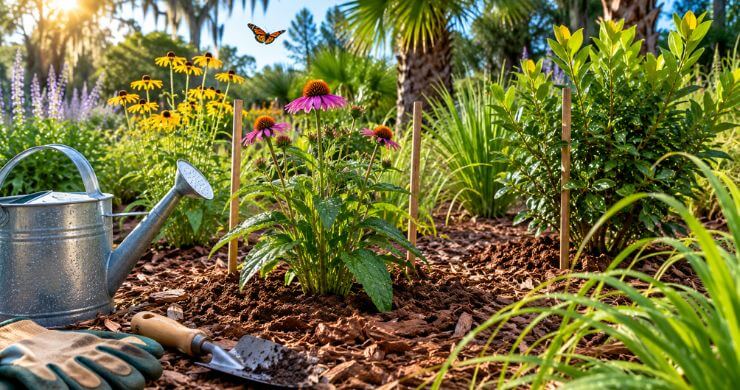
Organic mulch creates a buffer between summer weather and young roots. The Florida-Friendly Landscaping Program recommends two to three inches of mulch to conserve moisture, moderate soil temperature, and reduce competition.
Mulch should remain one to two inches away from stems, trunks, and crowns. A mound against the plant can trap moisture where tissues should stay exposed. UF/IFAS planting guidance also advises spreading mulch around the outside of the root ball instead of covering its top.
Pine bark, pine straw, shredded leaves, and mixed hardwood mulch can support an organic garden. The material should stay loose, admit water, and break down gradually without forming a sealed layer.
Temporary shade may help a newly planted specimen during an unusual heat spike. However, shade should not become a permanent correction for a plant placed in unsuitable light.
Recognize Heat Stress Before Damage Becomes Severe
Common warning signs include persistent wilting, curled leaves, brown edges, bleached patches, leaf drop, and little new growth. University of Minnesota Extension advises checking the soil before assuming that wilt means the plant needs more water.
Timing offers another clue because a plant that droops briefly during peak heat may recover as temperatures fall. A plant that remains wilted the next morning deserves closer inspection.
The gardener should first examine moisture several inches below the surface. Dry soil may call for slow watering at the root ball. Wet soil may point to poor drainage, damaged roots, or excessive irrigation.
Scorched tissue on the sunniest side may suggest excessive exposure, while yellowing paired with wet soil may indicate root stress. A plant that struggles repeatedly may be poorly matched to the site.
During extreme heat, unnecessary pruning or transplanting can add stress. University Extension guidance recommends postponing pruning until conditions moderate, so the plant can stabilize instead of supporting immediate top growth.
Help Young Plants Build Roots for Future Seasons
Strong roots matter more than quick foliage during the establishment period for young native plants. Gardeners can support that goal by maintaining steady moisture, preserving mulch depth, removing nearby competition, and avoiding repeated disturbance.
They should also resist adding extra inputs simply because growth appears slow. Heat often pauses visible growth while the plant conserves energy. New leaves may return after temperatures ease and roots reach more soil.
Observation remains the most useful routine throughout summer because conditions can change quickly after rain or dry spells. A brief root-zone check can reveal whether soil dries too quickly or stays wet too long. Notes about wilting, sun exposure, and recovery can prevent repeated guesswork.
Once a native plant becomes established and suits its site, it may need little supplemental irrigation outside prolonged dry periods. That lower-maintenance stage follows careful establishment, rather than arriving on planting day.
Frequently Asked Questions
These questions address common concerns about watering, heat, and establishment during a young plant’s first summer. Each answer should be adjusted for the species and conditions in a specific garden.
How often should young native plants be watered in summer?
There is no universal schedule because rainfall, drainage, plant size, weather, and time since planting all affect moisture needs. The root ball should stay consistently moist during early establishment without remaining saturated.
Can a Florida native plant receive too much sun?
A Florida native plant can receive too much sun when its natural light needs do not match the planting site. A shade-adapted species may scorch in afternoon sun, while a sun-loving plant may show temporary stress before its roots establish.
How can gardeners tell whether a native plant needs water?
They should check moisture in the root zone instead of relying only on wilted leaves. Dry soil supports watering, while moist soil suggests that heat, drainage, root damage, or site mismatch may be involved.
How long does it take a native plant to become established?
The period varies by species, plant size, season, soil, and care. UF/IFAS estimates that landscape shrubs may need about 20 to 28 weeks, while larger plants can require more time.
Keep Growing with Michelle in the Meadow
I share practical, organic gardening lessons from real successes and setbacks in Northeast Florida. Readers can visit Michelle in the Meadow and follow my gardening journey for more seasonal guidance.
