

Summary
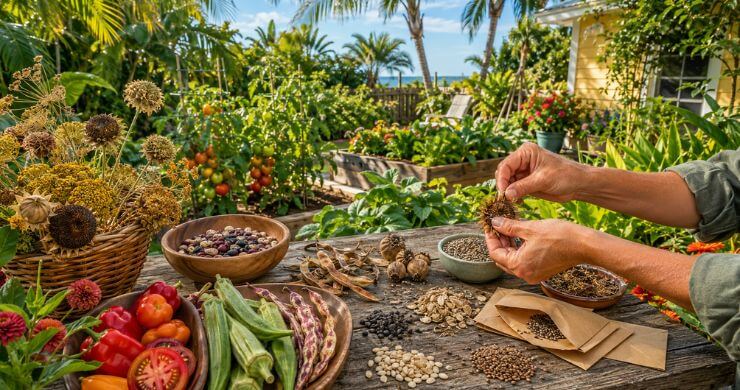
Seed saving in Florida gives gardeners a window each summer to collect locally adapted seeds. Crops like Everglades tomatoes, Datil peppers, southern peas, okra, and Seminole pumpkin reach peak maturity from July through September. Timing and storage make the difference between viable seeds and wasted effort.
Generic seed packets sold nationwide often disappoint in Zone 9B soil. Heat, humidity, sandy substrate, and a long growing season create conditions that most commercial seed stock was never trialed against.
Seed saving in Florida solves this problem. Seeds collected from a Zone 9B harvest adapt to local pressures with each successive generation, producing plants better suited to the region than any national brand can offer. This guide covers which summer crops to collect, how to harvest and clean seeds, and how to store them through the humid off-season.
Why Summer is Prime Time for Seed Saving in Florida
Northeast Florida sits in USDA Zone 9B, where summers run long, hot, and humid. Many cool-season crops fail by June, but heat-adapted vegetables push into their most productive stretch. According to UF/IFAS Extension, many Florida gardens treat summer as their off-season for traditional crops.
The timing window is narrow. Peak seed maturity for most Zone 9B summer crops falls between July and September, before fall rains and mold pressure close the door. Seeds saved from that window carry the genetic memory of local conditions, and they outperform generic national stock over successive seasons.
Summer heat also plays a practical role in drying. Seeds harvested in July and August benefit from warm, breezy days that speed air-drying before storage. Gardeners who wait until October often face higher humidity and shorter daylight hours, both of which slow drying and raise the risk of mold.
Starting a seed-saving habit during summer also aligns with the natural lifecycle of the best-adapted crops. Plants that thrived through the hottest months have already proven their tolerance, and their seeds carry that advantage forward into next year's garden. Each season of selection strengthens the line further.
The Best Summer Crops to Collect Seeds from Now
Zone 9B rewards gardeners who focus on plants suited to heat and humidity. UF/IFAS Gardening Solutions identifies several summer crops as reliably productive in Florida's toughest months. Most are also excellent choices for beginner seed savers. The strongest candidates for Zone 9B include:
- Everglades tomatoes, a wild-type variety that fruits through Florida summer heat
- Datil peppers, the St. Augustine regional specialty
- Southern peas, including cowpeas, crowder, and black-eyed peas, which dry on the plant
- Okra, whose pods brown and crackle on the plant at seed maturity
- Seminole pumpkin, a Florida-native squash suited to heat and humidity
- Roselle, a hibiscus relative that produces late summer into fall
Self-pollinating crops like tomatoes, peppers, southern peas, and okra are the easiest for beginners because they rarely cross with other varieties. The UF/IFAS Beginner's Guide notes these plants can produce viable seeds from a single specimen.
One important caveat applies. Hybrid seeds will not grow true to type, and F1 offspring can be inedible or misshapen. Heirloom and open-pollinated varieties are the right choice. Seed packets typically note whether a variety is open-pollinated or hybrid, so checking the label before planting saves disappointment at harvest.
How to Harvest and Clean Summer Garden Seeds
Harvest timing depends on whether crops are wet-fruited or dry-fruited. Tomatoes, peppers, and Seminole pumpkin are wet-fruited, with seeds mature when the fruit is fully ripe or slightly past. Fruits should stay on the plant until peppers reach full color, tomatoes go soft-ripe, and squash rinds harden.
Beans, southern peas, okra, and other dry-fruited crops work differently. Pods and seedheads stay on the plant until brown and crackly. According to the UF/IFAS Beginner's Guide, harvesting slightly early is acceptable when heavy rain is expected, because pathogens can spoil pods in wet conditions.
Wet seeds benefit from a short fermentation. A few days in a shallow water bath breaks down the germination-inhibiting gel coating on tomato seeds. Rinse and spread flat to air-dry until brittle. Seeds that still clump after drying need more fermentation time.
Dry seeds are simpler. Shell fully dry pods by hand or in a paper bag, then winnow the chaff. Leftover material holds moisture and invites mold.
Cross-pollination needs planning. Peppers cross readily, so different varieties should be separated or hand-pollinated to keep seed lines pure. Squash varieties within the same species also cross, so isolation or hand-pollination matters for true seed.
Storing Seeds through Zone 9B's Humid Off-season
Storage is where seed saving in Florida gets tested. Ambient humidity in Zone 9B destroys seed viability faster than heat alone, and even well-harvested seeds can lose germination potential if stored poorly.
The UF/IFAS Beginner's Guide identifies four storage principles: dry, cool, stable, and dark. Dryness is the most important and hardest to achieve in the humid Southeast. Every one-percent drop in moisture content roughly doubles a seed's storage life.
Ideal seed moisture sits between five and ten percent, which needs help in Florida. Silica gel packets or clay zeolite beads inside a sealed jar pull ambient moisture out. A small hygrometer inside the jar signals when seeds are dry enough for long-term storage.
Once dry, seeds go into airtight glass jars with rubber-gasket lids. The back of a refrigerator works well because temperature and humidity stay stable. A freezer works too, but only for seeds already below the eight-percent moisture threshold.
Label every packet with crop, variety, and collection date. Most garden seeds stay viable for two to ten years, though germination drops annually. Using saved seeds within one year is safest. Additional gardening articles cover more Zone 9B growing topics.
Frequently Asked Questions
These are the questions Zone 9B gardeners ask most often about seed saving.
When should Northeast Florida gardeners start saving seeds from summer crops?
Most Zone 9B summer vegetables reach seed maturity between July and September, according to UF/IFAS planting guidance for North Florida. Physical cues like fully colored peppers or brown crackly pods are more reliable than a calendar date.
Can seeds from hybrid vegetables be saved?
Seeds saved from F1 hybrids will not grow true to their parents, and offspring can be unpredictable. Heirloom and open-pollinated varieties, clearly labeled on seed packets, are the right choice.
How long do saved seeds last in Zone 9B's humid climate?
Most garden seeds stay viable for two to ten years under good storage, though germination drops annually. In Zone 9B, ambient humidity shortens that lifespan, so using seeds within one year is most reliable. Airtight containers, desiccants, and cool storage extend viability.
Which summer vegetables are easiest for a first-time Zone 9B seed saver?
Self-pollinating crops are easiest because they rarely cross with other varieties. Southern peas, beans, tomatoes, and peppers all qualify. Southern peas and okra dry down on the plant with almost no intervention, making them especially forgiving for beginners.
Grow your seed collection with me
Have you tried seed saving in Florida from your Zone 9B summer garden? I'd love to hear which crops worked best for you in the comments. If you want to see more of my growing experience, you can learn more about my gardening journey on the blog.
Leave a Reply