

Certain microscopic roundworms can target insect pests while they’re in the soil. Beneficial nematodes for garden pest control are useful species that infect specific insect hosts and introduce symbiotic bacteria, which can kill those hosts in 24 to 48 hours. The right match matters: different nematode species target different pests and life stages.
Finding damaged roots, chewed leaves, or tiny flies around plants can leave you wondering what’s happening beneath the surface. Beneficial nematodes for garden pest control can help with certain soil-dwelling pests, but they aren’t a one-size-fits-all fix. The pest and its life stage determine which species or blend may be appropriate.
Here, you’ll learn what beneficial nematodes are, how blends work in garden soil, and which pests they can help control, including grubs, fungus gnat larvae, and cutworms. You’ll also see what conditions help them move through soil and find their targets, so you can make a more informed choice for your garden.
Key Takeaways
- Match the nematode species to the pest and its life stage; different types target different soil-dwelling insects.
- Moist soil and suitable temperatures help nematodes move through the root zone and find insect hosts.
- Timing matters: target grubs and vine weevil larvae when they’re actively feeding near plant roots.
- Use the article’s practical guidance to assess your garden’s soil needs and choose your next learning or planning step.
What are beneficial nematodes?
Beneficial nematodes are microscopic roundworms in the phylum Nematoda. In pest control, selected species seek insect hosts in soil or growing media.
Infection and Insect Host Control
Infective nematodes enter a susceptible insect through its body openings or, in some species, through softer body tissues. They release symbiotic bacteria inside the host, and the bacteria help kill it. The nematodes then feed and reproduce within the insect. Hosts can die within 24 to 48 hours after the bacteria are introduced. Match the nematode species to the pest, not just to the plant showing damage.
Target Insect Pests
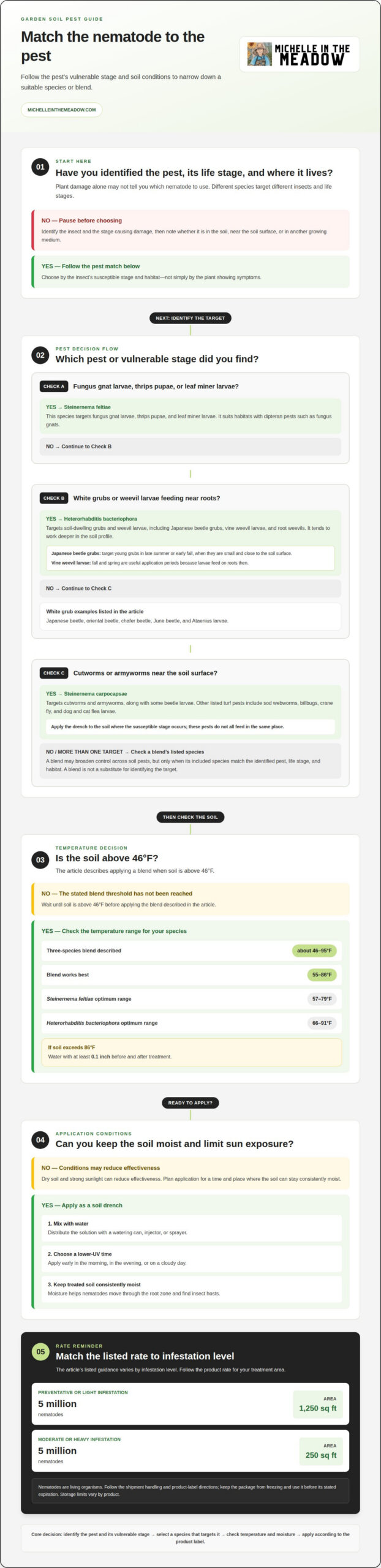
Different species target different insects and life stages. Heterorhabditis bacteriophora can target white grubs, including Japanese beetle, oriental beetle, chafer beetle, June beetle, and Ataenius larvae. Steinernema feltiae targets fungus gnat larvae, thrips pupae, and leaf miner larvae. Identifying the pest and where it develops helps you choose an appropriate treatment.
Nematodes control pests through infection by living organisms, unlike chemical pesticides. Other biological controls work through different organisms or mechanisms, so compare the target pest and where it feeds before choosing an approach.
The United States Environmental Protection Agency has ruled that nematodes are exempt from registration because they occur naturally and require no genetic modification by humans. This federal ruling does not describe state-specific requirements.
Nematodes target susceptible insect hosts. Available evidence reports no development of parasitic nematodes or their symbiotic bacteria in vertebrates. This does not establish a blanket claim about every species’ effects on pollinators, so follow the product label and avoid exposing non-target insects.
Application rates depend on infestation level. Listed guidance uses 5 million nematodes per 1,250 square feet for preventative or light infestations, and 5 million per 250 square feet for moderate or heavy infestations. Use the product’s rate for your treatment area.
Nematodes are living organisms, so follow the shipment’s handling directions when it arrives and apply them as directed. Store the package according to its label, keep it from freezing, and use it before its stated expiration. Storage limits vary by product.
Beneficial nematode blends for garden soil pests
A blend combines species with different hunting habits, extending control across soil pests. Choose by identifying the pest, its life stage, and where it lives.
Blend and Species Selection
Start with the insect and its habitat, not the plant symptom alone. Steinernema feltiae suits habitats with dipteran pests, such as fungus gnats. Steinernema glaseri moves readily through soil and can target white grubs. Heterorhabditid nematodes tend to work deeper, around 3 to 6 inches into the soil profile. A blend can broaden the targets, but match its listed species to the pest you’ve identified.
Species and Target Pest Matching
In ornamental beds, match the species to the pest’s damaging stage. Steinernema carpocapsae can control turf pests such as cutworms, sod webworms, dog and cat flea larvae, billbugs, and crane fly. Heterorhabditis bacteriophora targets soil-dwelling grubs and weevil larvae. These biological controls aren’t interchangeable: the pest’s location and life stage guide selection.
Garden Soil Application Steps
Apply nematodes as a soil drench. Mix them with water, then distribute the solution using a watering can, injector, or sprayer. Apply early in the morning, in the evening, or on a cloudy day to reduce UV exposure. Keep the soil consistently moist so nematodes can move and hunt. Dry soil and strong sunlight can reduce their effectiveness.
Application Timing and Soil Temperature
Apply a blend when soil is above 46°F; it works best around 55-86°F. Species have different optimum ranges: 57-79°F for S. feltiae, and 66-91°F for H. bacteriophora. A three-species blend is described as tolerating roughly 46-95°F. If soil exceeds 86°F, water with at least 0.1 inch before and after treatment. For more practical garden planning, explore gardening educational content.
Grub, vine weevil, cutworm, and armyworm control
Match the nematode species to the pest’s soil-dwelling stage. Heterorhabditis bacteriophora targets Japanese beetle grubs, vine weevil larvae, and root weevils. Steinernema carpocapsae targets cutworms, armyworms, and some beetle larvae. A species suited to grubs may not be the best match for caterpillars feeding near the soil surface.
Timing helps place nematodes near vulnerable pests. Apply against Japanese beetle grubs in late summer or early fall, when young grubs are small and close to the soil surface. For vine weevil larvae, fall and spring are useful application periods because larvae feed on roots then. Identify the pest first, then time the application to its feeding stage rather than relying on plant damage alone.
For a product marketed as Grub-Away® Nematodes, use its label to compare the listed nematode species and target pests with the problem in your garden. The name alone doesn’t reveal which species it contains or whether it covers vine weevil larvae. Look for H. bacteriophora when targeting Japanese beetle grubs or root weevils, and follow the product’s application directions.
For cutworms and armyworms, check whether the target species is S. carpocapsae. It can also control some beetle larvae; turf targets include sod webworms, billbugs, crane fly, and dog and cat flea larvae. These pests don’t all feed in the same place, so apply the drench to the soil where the susceptible stage occurs. Keep treated soil moist so nematodes can move and hunt. If damage continues, identify whether the same pest is still active before choosing another treatment. A suitable species-pest match, correct timing, and moist soil all matter.
Beneficial nematodes for pest control
Good results depend on more than choosing a species. Coverage, soil moisture, and timing affect whether nematodes reach insect hosts. Treat the infested soil, not just visible plant damage, and follow the product label. For beneficial nematodes for garden pest control, the practical takeaway is simple: match the treatment to the pest, then support nematode movement through the soil.
Match the application rate to pest pressure and treated area. For preventative or light infestations, the listed rate is 5 million nematodes per 1,250 square feet. For moderate or heavy infestations, it is 5 million per 250 square feet. Measure the treatment area first, then distribute the solution evenly across affected soil. Avoid concentrating it in one spot, since pests may occupy a wider root zone.
Mix nematodes with water between 59°F and 69°F. For a watering can or pump sprayer, mix 5 million nematodes with 1 to 5 gallons of water. A hose-end sprayer should have a nozzle at least 0.8 mm wide, with spray pressure at or below 72 PSI. Apply early in the morning, evening, or on a cloudy day to limit ultraviolet exposure.
Keep the soil moist for 2 to 3 weeks after treatment. The mixed solution remains viable for up to 6 hours, but weakens as it sits, so apply it promptly. For continuing pest pressure from fleas or fungus gnats, reapplication roughly every 3 to 4 weeks is recommended. If damage persists, guidance also recommends reapplying at seven-day intervals. Check product directions before mixing with insecticides, herbicides, or fertilizers, since compatibility varies.
Choosing beneficial nematodes for garden pest control also means planning for aftercare, not only application day. Note where damage continues and whether the same pest remains active before deciding on another treatment. For practical garden planning, explore gardening education and pest-control advice.
Michelle In The Meadow: Soil Calculator for Raised Beds
Michelle In The Meadow’s Soil Calculator for Raised Beds helps estimate the soil needed for a raised-bed project. It’s useful when planning a new bed or refreshing its growing medium, while pest identification and nematode selection remain separate decisions.
Michelle In The Meadow’s gardening educational content can help you build practical knowledge about garden care, and its curated gardening product recommendations can guide your product research. These resources support thoughtful planning, but a soil-volume calculation isn’t a pest-control treatment.
Explore Michelle In The Meadow’s gardening resources to plan your next project.
Make your next garden step a thoughtful one
Using beneficial nematodes for garden pest control starts with noticing patterns, not rushing to treat every damaged leaf. Keep a simple garden note: record where symptoms appear, which plants are affected, and whether the damage changes after care. These observations can help you make a more informed decision the next time you inspect the bed.
Let your next step fit the garden you’re actually growing. You might be planning a raised bed, learning about soil care, or looking for relevant gardening products. Michelle In The Meadow’s resources can support your planning as you develop a practical approach for your space.
Contact Michelle In The Meadow to explore your next gardening step. A little observation and a clear plan can make caring for your garden feel more manageable.
Frequently Asked Questions
What are the target insects?
Beneficial nematodes target specific insect larvae and pupae that live in soil or growing media. Examples include white grubs, fungus gnat larvae, thrips pupae, leaf miner larvae, cutworms, and armyworms. Exact targets depend on the nematode species, so identify the insect and its life stage before selecting a treatment. Check the product’s target list to see whether it fits the pest you’ve found.
Which Nematode Species Works Best for Which Problem?
The best species depends on the pest and where it develops. Steinernema feltiae is suited to fungus gnat larvae, thrips pupae, and leaf miner larvae. Heterorhabditis bacteriophora targets grubs and weevil larvae, while Steinernema carpocapsae can target cutworms and armyworms. For white grubs, Steinernema glaseri is another option with increased mobility through soil.
Why are these organisms beneficial?
Selected nematodes help control certain insect pests by infecting their hosts, rather than acting as a general-purpose treatment for every garden problem. Inside susceptible hosts, they release symbiotic bacteria that contribute to the insect’s death. Their value comes from matching a living control to a suitable pest stage. They won’t replace sound pest identification or address unrelated problems such as weeds or plant disease.
Which beneficial nematode species control common garden pests?
For Japanese beetle grubs, vine weevil larvae, and root weevils, look for Heterorhabditis bacteriophora. Steinernema feltiae is used against fungus gnat larvae, thrips pupae, and leaf miner larvae. Steinernema carpocapsae can target cutworms, armyworms, and some beetle larvae. Read the listed targets carefully: a species effective against one pest may not address another.
What garden pests do beneficial nematodes target, and which do they not control?
Beneficial nematodes can target susceptible insect stages associated with soil, including grubs, fungus gnat larvae, cutworms, and some beetle larvae. They aren’t a broad treatment for every garden insect. For example, a nematode aimed at soil-dwelling larvae won’t address an unrelated pest feeding on foliage as an adult. Use the species’ target information to distinguish suitable pests from problems outside its range.
How often should beneficial nematodes be applied, and how long do they take to work?
Insect hosts can die within 24 to 48 hours after nematodes introduce their symbiotic bacteria, though that timing describes host death, not when garden damage stops. Reapplication depends on pest pressure: guidance suggests every 2-3 weeks for moderate cyclical pressure, or roughly every 3-4 weeks for continuing fleas or fungus gnats. Keep the soil moist and follow the product label’s schedule.
