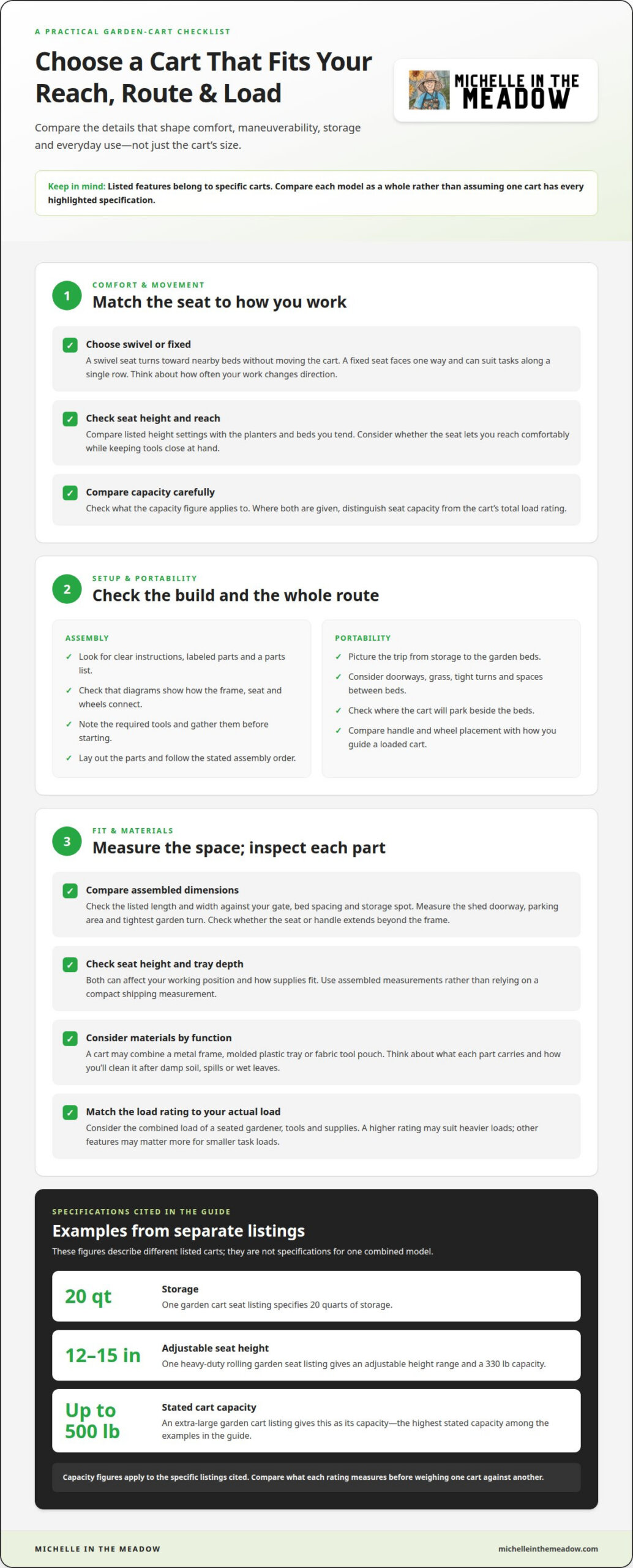
The largest cart isn’t automatically the best fit: a rolling garden cart with seat and tool storage should match your reach, the tools you carry, and the paths around your garden. One garden cart seat listing specifies 20 quarts of storage, while a heavy-duty rolling garden seat listing gives a 330-pound capacity and adjustable seat height from 12 to 15 inches. Those figures describe separate listings, so compare each cart’s features as a whole.
It makes sense to want a comfortable seat and handy storage without ending up with a cart that’s awkward to move or difficult to assemble. The details matter just as much as the idea of sitting while you work.
This guide compares seat adjustability, assembly, portability, dimensions, and materials to help you narrow down your options. You’ll also find a criteria table and a practical decision guide, so you can weigh what matters most for your garden, from comfortable reaching to maneuvering between beds.
Key Takeaways
- Choose a seat that adjusts and swivels in a way that suits the tasks and reach involved in your garden.
- Consider assembly needs and how easily the cart can move along your garden paths and around beds.
- Compare the cart’s overall dimensions and materials with your available storage space and the conditions where you’ll use it.
- Use the decision guide to weigh storage, comfort, and maneuverability against the features you’ll actually use.
Adjustable swiveling seat
A swivel seat makes it easier to turn toward nearby beds without moving the cart. A fixed seat faces one direction, which can work well for tasks focused on a single row. When pruning plants on both sides of a narrow path, for instance, a swivel can help you reach either side while seated. Choose based on how often your work changes direction.
Seat adjustment matters when a cart serves different tasks or gardeners. One heavy-duty rolling garden seat listing gives a 330-pound capacity and an adjustable seat height from 12 to 15 inches. That range offers distinct settings to compare, rather than assuming every adjustable seat moves the same amount. Consider whether the seat height lets you reach a planter comfortably while keeping tools close at hand.
Swivel-seat garden carts make it easier to turn toward adjacent plants while seated. With a fixed seat, you’ll need to reposition yourself or the cart to change your reach. A fixed position may be enough for weeding along a straight bed, while a swivel can reduce repositioning when you move between nearby containers.
Compare the seat type alongside adjustment and capacity details. A capacity figure describes a listed model, not every cart, so use it only for that option. The table highlights the practical trade-offs to weigh before choosing.
| Seat option | Movement | Adjustment | Best fit |
|---|---|---|---|
| Swiveling | Turns toward nearby work | Compare listed height settings | Changing direction between beds |
| Fixed | Stays forward-facing | Compare seat height and capacity | Tasks along one row |
Choose a swivel seat if you often turn between work areas; choose a fixed seat for tasks that keep you facing one way.
Assembly and portability
Assembly affects how soon a cart is ready for the garden path. Look for clear instructions, labeled parts, and a parts list that makes missing hardware easy to spot. Diagrams showing each connection can help you assemble the frame, seat, and wheels in order. Lay out the parts on a clear floor, especially if the tray or handle attaches separately.
For a rolling garden cart with seat and tool storage, portability depends on the route between your shed and garden beds. Picture moving through a doorway, across grass, and around a planter. A cart that fits through the doorway may still be awkward at a tight turn. Consider the whole route, including where you’ll park it beside the beds.
- Review the assembly sequence. Check whether the instructions identify each part and show how the frame, seat, and wheels connect. Follow the stated order to avoid undoing a completed step.
- Plan for the required tools. Note which tools the instructions call for and gather them before starting. This is useful if the cart needs a particular wrench or screwdriver for its fasteners.
- Picture the finished route. Consider turns around a compost bin, narrow spaces between beds, and the doorway to your storage area. Each spot reveals a different portability constraint.
Handle and wheel placement can affect how naturally you guide a loaded cart. A clear path from a potting area may suit steady forward movement, while closely spaced containers require careful turns. Compare the cart’s design with your route instead of judging portability by its wheels alone.
Before choosing a rolling garden cart with seat and tool storage, compare its assembled dimensions with your storage space. Measure the shed doorway and parking area, too. These checks help you avoid a cart that blocks an aisle or garden gate and ensure it fits your routine.
Cart dimensions and materials
Compare the cart’s footprint, construction, and load rating with the beds and tools it will serve. These details determine where it fits and what it can carry.
Cart Dimensions
Cart dimensions mean more than overall size. Compare the listed length and width with your garden gate, bed spacing, and storage spot. A cart may fit beside a raised bed but take up too much room in a narrow shed aisle. Check seat height and tray depth as well, since both affect your working position and how supplies fit.
Check the assembled dimensions rather than relying on a compact shipping measurement. Note whether the seat or handle extends beyond the main frame, especially if the cart must pass through a doorway or fit beneath a potting bench. Measure the tightest turn in your garden for a practical comparison.
Cart Materials
Materials can differ across a cart’s frame, tray, seat, and tool holders. One model might pair a metal frame with a molded plastic tray; another might use a fabric pouch for hand tools. Consider each part’s purpose. A tray holding damp soil may need different cleanup than a pouch carrying pruners and seed packets.
Consider where the cart will stay between gardening sessions. In a shed, check how much space the frame needs and whether removable parts make storage easier. Near a potting area, consider how to clean the tray and tool holders after spills or wet leaves. Material matters most where mess and handling meet.
Weight Capacity
Among the listed examples, an extra-large garden cart supports up to 500 lb, making it the highest stated capacity here. That figure belongs to that cart listing, not every large cart. Compare the rating with the combined load of a seated gardener, tools, and supplies, and distinguish seat capacity from the cart’s total load rating where both are given.
Picture a real load, such as a bag of compost alongside a hand trowel and watering can. A higher rating may suit heavier loads, while a smaller task load may make other features more useful. Match the stated capacity to what you plan to carry, not the cart’s size alone.
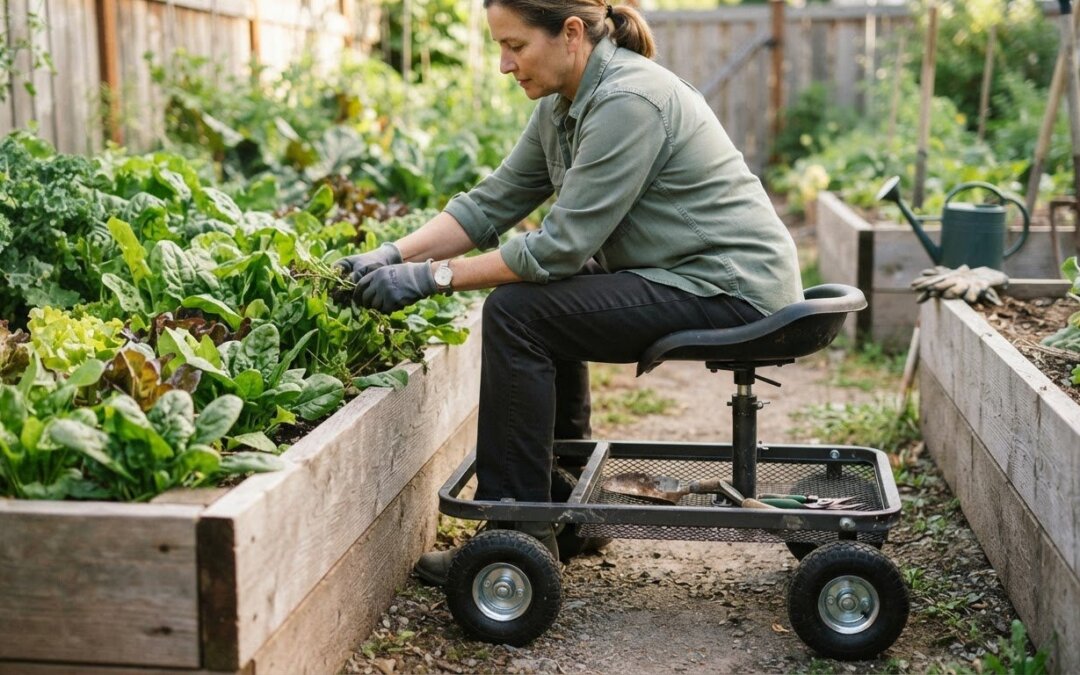
Rolling garden cart with built-in seat
A built-in seat stays attached to the cart, while tool storage keeps frequently used items close. Choose a design that suits your gardening tasks and holds the tools you reach for most.
Features such as construction, seat design, and storage vary, so compare what each model includes rather than relying on price alone. Look for a stable base and securely attached seat. If the cart has wheel locks, consider their placement and ease of use.
Built-In Seats
A built-in seat combines a place to sit with a rolling frame, unlike a separate garden stool that must be moved on its own. Compare seat shape, height adjustment, and swivel function, then consider your seated tasks. Turning between pots may call for a swivel, while tending one straight bed may suit a fixed seat.
Check that the seat leaves room for your legs and doesn’t block access to the cart’s contents. A seat may feel convenient beside a raised bed but be less useful if it keeps you from reaching the tray or tool holders.
Built-In Tool Storage
Storage can take the form of a tray, pouch, or holders attached to the cart. These options serve different needs: a tray can keep gloves and a trowel together, while holders can keep frequently used tools within reach. One garden cart seat listing specifies 20 quarts of storage space, a useful reference when comparing capacity.
Start with your usual tasks. Accessible holders can keep pruners close while pruning; a larger compartment may suit gloves and seed packets when planting. Check that you can reach stored items while seated.
Cart Costs
There’s no single cost for every seated garden cart. Seat adjustability, storage capacity, materials, and load rating all affect what a model offers. Compare carts by the features you’ll use rather than assuming a higher price means a better fit.
A gardener carrying only hand tools may value accessible holders more than a large storage area. Someone moving heavier supplies may prioritize the listed load capacity. Comparing these trade-offs makes cost comparisons more useful.
Seat Safety Features
Check how securely the seat attaches to the frame and whether the cart has a stable base. If it includes wheel locks, consider whether they’re easy to reach while seated. These details help you assess the design without assuming every cart has the same features.
Consider the surface where you’ll sit and work. A level path beside a raised bed differs from uneven ground near a compost pile. Match the cart’s listed capacity to its intended use, and arrange tools so they don’t interfere with sitting or standing.
Michelle In The Meadow
Michelle In The Meadow helps gardeners turn product questions into practical decisions through gardening educational content and curated gardening product recommendations. If you’re weighing a cart’s seat, storage, dimensions, and materials, these resources can help you focus on the features that suit your garden and routine. For raised-bed projects, the Soil Calculator for Raised Beds can help estimate the soil needed, while the broader gardening guidance supports planning the work around your space. Together, these offerings connect equipment choices with the garden tasks they’ll support, from moving tools between beds to keeping supplies close at hand. Contact Michelle In The Meadow to explore gardening guidance and recommendations for your needs.
Choose for the Work You Want to Do Next
Before choosing a cart, think about the gardening tasks you want to make easier. You might be moving between planting, pruning, and tidying, or simply want to keep the day’s essentials together. Let your routine guide your choice. A rolling garden cart with seat and tool storage should support the way you work, not become another thing to manage.
Picture how the cart will fit into your garden through a full season. Will it make a regular task more comfortable? Will it suit the way you move through your space? Keeping everyday tasks in mind can clarify your choice and help you focus on what matters.
If you’d like a little more guidance as you plan your garden, contact Michelle In The Meadow. Take the next step at your own pace, and enjoy making your garden work better for you.
Frequently Asked Questions
What are the dimensions and storage capacity of popular garden carts with seats?
Dimensions and storage capacity vary by cart, so compare the assembled footprint with your narrowest garden gate and storage space. A compartment’s stated volume won’t tell you whether it fits long-handled tools, gloves, or small pots. Consider its shape as well as its capacity: a deep bin suits loose supplies, while separate sections can keep smaller items easy to find.
What materials and wheels work best for different garden terrain?
The best combination depends on your route. On smooth patios and firm paths, prioritize easy steering and a cart that fits your turns. On grass or uneven ground, compare wheel width and construction, and consider how the loaded cart handles bumps. Match the frame and tray materials to your cleanup needs, especially if you regularly carry damp soil or wet plant debris.
Which garden carts include tool trays, baskets, or tool holders?
Look for a storage layout that suits the tools you carry. Designs vary, with trays, baskets, and holders serving different purposes. A tray can keep gloves and a hand trowel together; a basket can contain loose items such as seed packets. Dedicated holders keep frequently used tools within reach. Check that each storage area remains accessible while seated.
How do you assemble and maintain a rolling garden cart with a seat?
Follow the instructions to assemble the cart, identifying the frame, wheels, seat, and fasteners before joining the parts. When assembly is complete, check that the seat and handle feel secure and the wheels turn freely. After gardening, remove soil and plant debris, then store the cart dry. Periodically inspect moving parts and tighten loose fasteners according to the manufacturer’s guidance.