A garden trowel with one-piece construction has no neck joint to fail, making it a strong option for durability. But a sturdy build is only part of the decision. Useful ergonomic garden hand trowel reviews also consider whether the grip feels comfortable and the blade suits your work.
Comfort matters when digging involves repeated hand movements. This guide helps you weigh durability against practical details, so you can choose a trowel for your garden instead of relying on one-size-fits-all praise. Compare construction, blade shape, and depth markings, then match those features to tasks such as digging and precise transplanting.
Key Takeaways
- Choose a handle that feels secure and comfortable in your grip, especially for repeated digging.
- For precise transplanting, look for a narrow blade with depth markings to help guide planting.
- Match trowel construction and blade shape to the work, from breaking into firm soil to placing small plants.
- Use the comparison and decision guide to narrow down which trowel features best fit your garden tasks.
What is the toughest garden trowel?
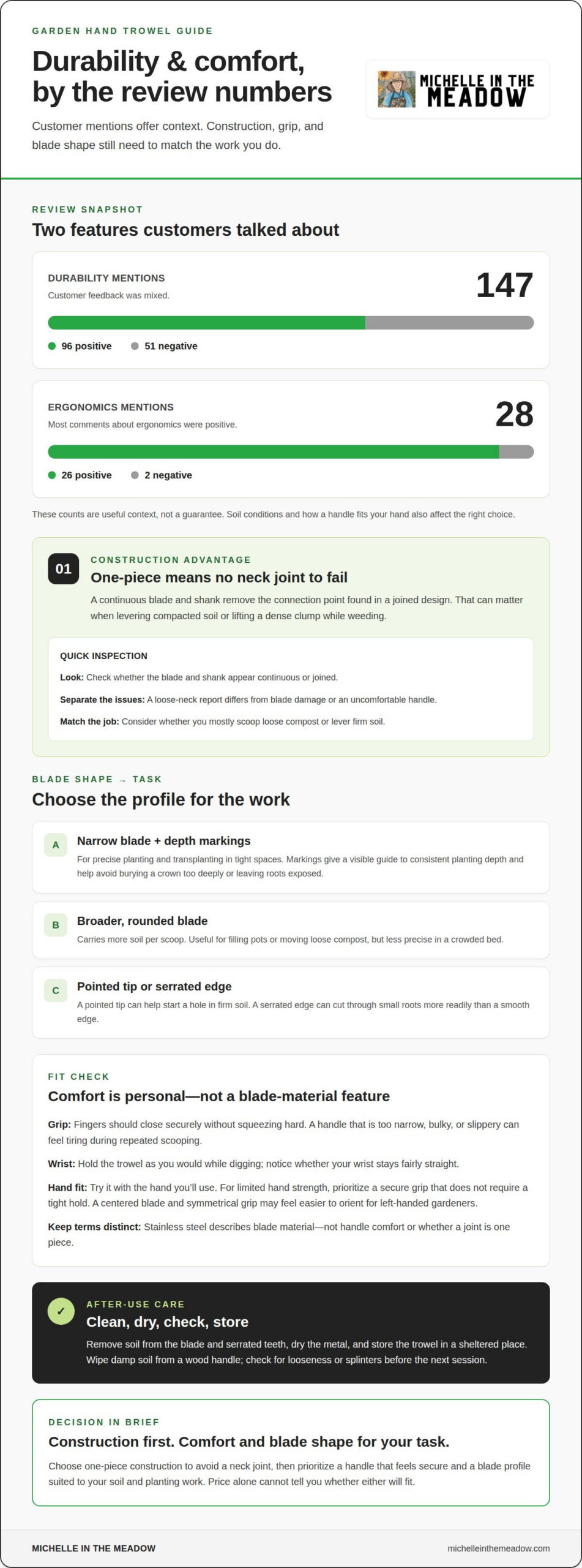
A one-piece trowel has no neck joint to fail, making its construction a practical strength advantage for tough digging. Durability reviews still show mixed experiences: 147 customers mentioned durability, with 96 positive and 51 negative mentions. Comfort matters too. In reviews, 28 customers mentioned ergonomics, with 26 positive and 2 negative mentions. These figures offer useful context, but the right choice still depends on the soil and the way the handle fits your hand.
To assess ergonomic comfort, consider the grip as well as the blade. Hold the handle as you would while digging, then notice whether your wrist stays fairly straight and your fingers close securely without squeezing hard. A handle that’s too narrow, bulky, or slippery can feel tiring during repeated scooping. For transplanting, a secure grip helps you guide the blade with control. Stainless steel describes the blade material, not the comfort of the handle or the durability of the joint.
If you have arthritis or limited hand strength, prioritize a handle that feels secure without requiring a tight grip and lets your wrist stay neutral. Try it with the hand you’ll use for digging, since comfort varies with hand size and handle shape. Left-handed gardeners can use a trowel if its handle and blade feel natural in the left hand. A centered blade and symmetrical grip may be easier to orient, while an angled design may feel less intuitive.
Price alone won’t tell you whether a handle fits or a blade suits your soil, so weigh construction and comfort alongside cost.
| Option | Construction and handle | Useful consideration |
|---|---|---|
| One-piece trowel | No neck joint | Fewer joint-related failure points |
| Japanese Serrated Edge Garden Trowel | Alloy steel blade; alloy steel and wood handle | 13.5 inches long; weighs 7.7 ounces |
| Ergonomic-grip trowel | Grip shape varies | Assess wrist position and hand fit |
After use, remove soil from the blade, dry it, and store the trowel in a sheltered place. Wipe damp soil off a wood handle and check for looseness or splinters before your next session. These simple steps help keep the grip comfortable and the blade ready for digging.
Choose one-piece construction to avoid concerns about a neck joint, then prioritize a handle that lets your wrist and fingers work comfortably.
Trowel blade shape and planting depth markings
Blade shape affects how a hand trowel moves through soil. A narrow blade with depth markings suits precise transplanting because it can enter a small planting space without disturbing as much surrounding soil. The markings also provide a visible guide for setting a root ball at a consistent depth. For seedlings, that reference can help you avoid burying the crown too deeply or leaving roots exposed.
A broader, rounded blade carries more soil with each scoop, making it useful for filling pots or moving loose compost. It may be less precise in a crowded bed. A pointed tip can help start a hole in firm soil, while a serrated edge can cut through small roots more readily than a smooth edge. Match the shape to the task: use a narrow profile around close-set plants and a broader bowl for moving soil.
Material affects both cutting and care. Stainless steel resists rust better than carbon steel, but still benefits from drying after use. Carbon steel can take a sharp edge, yet moisture left on the blade can encourage rust. Neither material makes a blade immune to damage. After digging in damp soil, remove clinging dirt and dry the metal before storing it. Clear soil from a serrated edge’s teeth so they’re ready to cut.
- Narrow blade: Choose it for precise planting and transplanting in tight spaces.
- Broad blade: Use it to scoop loose soil or fill a container.
- Depth markings: Use the visible scale to guide consistent planting depth.
- Serrated edge: Consider it when small roots make a smooth blade harder to push through.
Product listings may use broad labels such as “stainless” or “serrated,” so read the blade description for the feature you need instead of relying on the title alone. For a young plant, prioritize a narrow blade with depth markings; for moving compost, prioritize capacity. Choosing by task makes reviews easier to compare and connects blade shape to real planting work.
One-piece trowel construction and neck failure
A one-piece trowel has no neck joint to fail, removing a connection point between the blade and handle. That matters for tasks such as levering compacted soil or lifting a dense clump while weeding. In a joined design, the blade and handle meet at the neck, where repeated force is concentrated. Construction can help you judge whether a tool suits demanding digging, but it doesn’t tell you how comfortable the grip feels.
Look closely at the blade’s transition into its shank, the section that runs toward the handle. A continuous piece avoids a separate neck connection; a visible seam or fastener indicates joined construction. This distinction helps when reading reviews: a complaint about a loose connection points to a different concern than one about a bent blade or uncomfortable handle. Match the reported issue to the part of the trowel you’ll rely on.
Use this quick inspection sequence when reviewing a product description or photographs:
- Find the connection: Check whether the blade and shank appear continuous or joined.
- Read failure details: Separate reports of a loose neck from reports of blade damage.
- Match the task: Consider whether you’ll scoop loose compost or lever firm soil.
Material is a separate consideration. Stainless steel describes the metal, not whether the blade and neck form one piece. A sharpened edge may help with small roots, but it won’t prevent a joint from loosening under repeated pressure. A trowel used mainly to place seedlings faces different demands from one used to pry weeds from dense ground. Judge construction against your regular jobs, not a feature label alone.
Care can also help you spot developing problems. After digging, remove soil around the neck or seam, then dry the tool before storing it. Before the next use, look for movement at a joint, a visible crack, or a blade that no longer sits straight. Stop using a trowel if damage makes it unstable. These checks don’t change its construction, but they can reveal wear before your next weeding session.
For repeated levering in firm soil, favor a one-piece blade-and-shank design. For lighter planting, weigh construction alongside grip and blade shape.
Recommended trowels for different gardening needs
The best fit depends on the job, not a single “top-rated” label. Customer reviews of ergonomic models describe varied durability, while ergonomic comfort receives more favorable mentions. The Japanese Serrated Edge Garden Trowel is one option to consider. Compare its intended use with your regular garden tasks rather than assuming any model is right for everyone.
Use this four-option guide to match construction and blade style to the work:
| Option | Best suited to | Decision point |
|---|---|---|
| One-piece trowel | Digging that puts pressure on the neck | Favors continuous blade-and-shank construction |
| Narrow blade with depth markings | Precise transplanting | Offers a guide for planting depth |
| Broad, rounded blade | Moving loose soil or filling pots | Prioritizes scooping capacity |
| Japanese Serrated Edge Garden Trowel | Tasks that benefit from a serrated edge | Compare its handle feel and use case |
For tight spacing around seedlings, start with a narrow marked blade. For moving compost into a container, a broader scoop may suit the motion better. If your beds have firm soil, give construction extra weight in your decision. Then consider how the handle feels during the repeated movement your task requires. Length and weight also affect reach and control, so assess them alongside blade shape rather than in isolation.
Ergonomic garden hand trowel reviews can help you spot whether comments describe the task you have in mind. A report about a loose neck differs from feedback about grip comfort, and neither alone tells you how the trowel performs for every gardener. Look for experiences that match transplanting in close rows or digging into compacted ground. This makes customer feedback more useful than star ratings alone.
Choose by your most frequent job: narrow and marked for precise planting, broad for scooping, or one-piece construction for neck-joint concerns. Compare ergonomic garden hand trowel reviews with those priorities in mind, then explore garden tool recommendations to consider options suited to your gardening needs.
Customer feedback is more consistently favorable about ergonomic comfort than durability, which varies between users. The Japanese Serrated Edge Garden Trowel is an option for tasks that benefit from a serrated edge. Consider how its handle feels and whether it suits your intended use.
Michelle In The Meadow
Michelle In The Meadow shares gardening education and curated product recommendations to help gardeners turn tool comparisons into practical choices. If you’re weighing handle comfort against blade shape or construction, this guidance can help you connect a trowel’s features to the work you do in your garden.
For a raised-bed project, the Soil Calculator for Raised Beds can help you plan the soil you’ll need. Gardening guidance can support decisions beyond hand tools, too. Use product recommendations to explore options or educational content to build confidence with a gardening task.
If you’d like help finding useful gardening guidance, contact Michelle In The Meadow.
Put Your Next Garden Task First
Let the work ahead guide your choice. Before your next planting session, think about the motion you repeat most: reaching into a crowded bed, scooping soil into pots, or loosening ground around established plants. That task gives you a practical way to assess ergonomic garden hand trowel reviews without getting sidetracked by features you won’t use.
Your tool needs may change as your garden does. A trowel that feels right for one bed or planting job may not be your first choice for another. Keep your regular tasks in mind, and make comfort part of the decision rather than an afterthought.
For guidance as you plan your next gardening step, get in touch with Michelle In The Meadow. A thoughtful choice can make the work ahead feel more manageable. Happy gardening!
Frequently Asked Questions
How do I know which trowel to use?
Choose a trowel based on the task, soil, and space you’re working in. A narrow bed between established plants, for example, calls for a tool that’s easy to position without disturbing nearby roots. For a container garden, prioritize a blade that moves loose potting mix comfortably. Consider whether you need leverage, reach, or careful placement, then choose a shape and handle that support that movement.
Is a trowel good for weeding?
Yes, a hand trowel can help loosen soil around weeds and lift them out with their roots. Work the blade beside the weed, then gently ease the soil upward rather than pulling hard on the stem. This approach is useful in a crowded bed where a larger tool might disturb nearby plants. For weeds with deep or spreading roots, a trowel may not remove the entire root system.
What trowel is best for transplanting?
A narrow trowel is useful for transplanting because it can work in confined spaces without shifting as much soil around neighboring plants. For a small seedling, make a hole that accommodates its roots, then guide the plant into place without forcing or bending them. A depth scale can help you judge placement, while a comfortable grip supports controlled movements in a crowded container or bed.
What are the best-reviewed ergonomic garden hand trowels in the US?
There isn’t one best-reviewed trowel for every gardener, because comfort and performance depend on the task and the person holding it. The Japanese Serrated Edge Garden Trowel is one model to consider. Compare reviews for details about repeated use, digging conditions, grip comfort, and the work performed. Comments describing a similar garden task can be more useful than a general rating alone.
How do ergonomic garden trowels compare by handle design, grip, and comfort?
Handle comfort depends on how the shape fits your hand and supports your repeated movements. A rounded grip may feel different from a contoured one, while a textured surface can affect how securely you hold the tool with damp hands. Consider whether you tend to pinch the handle or wrap your fingers around it. That distinction can help you assess comfort during longer sessions.
What materials and blade shapes are best for durable garden hand trowels?
Durability depends on both the metal and how the blade connects to the handle. Stainless steel resists rust better than carbon steel, but drying the blade after damp work remains useful. Choose a blade shape to suit the job: a pointed profile can start a hole, while a rounded blade can move loose soil. For lasting use, consider construction, care, and your garden’s demands together.