
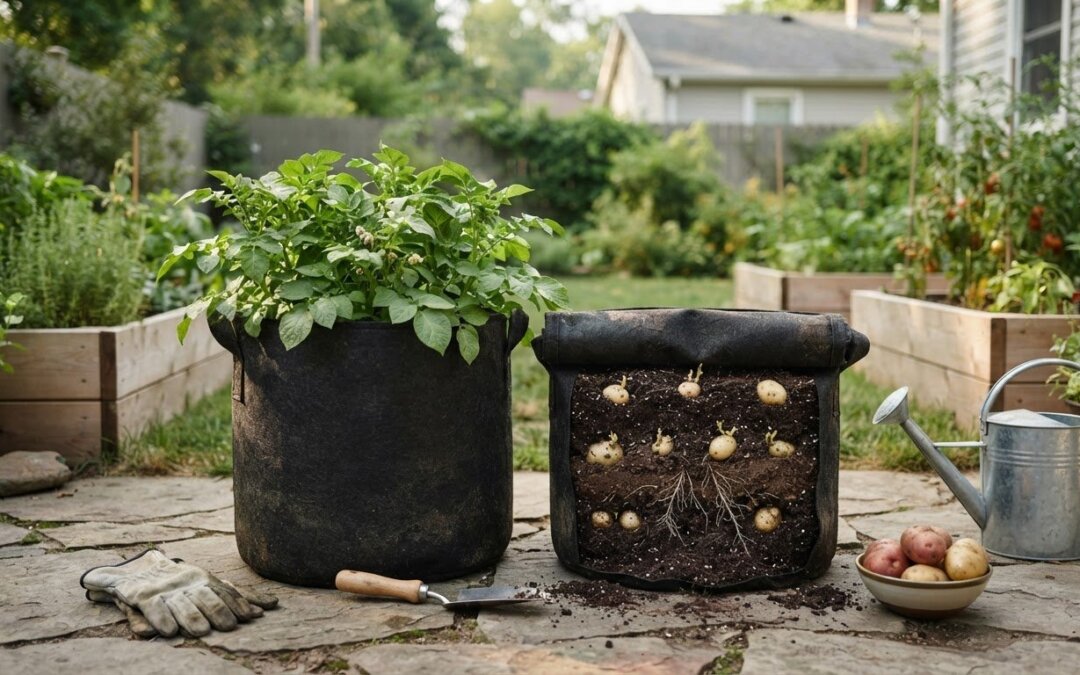
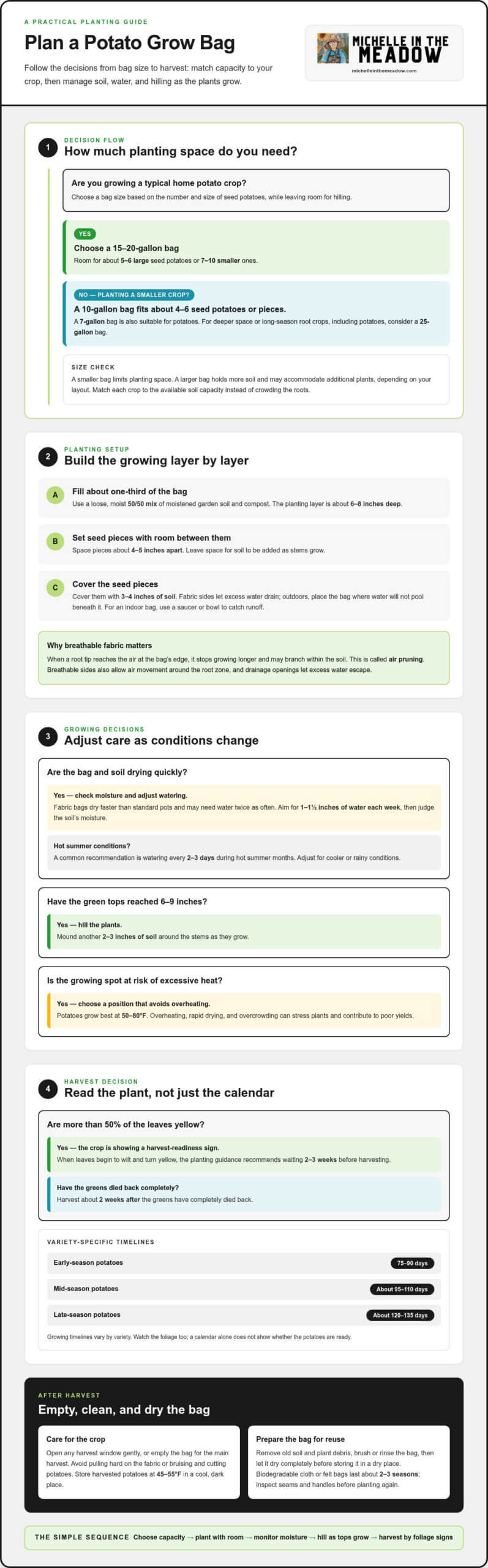
For most home potato crops, the best fabric grow bags for potatoes are 15- to 20-gallon bags, with room for about 5-6 large seed potatoes or 7-10 smaller ones. Fill the bag about one-third full with a 50/50 mix of moistened garden soil and compost, place seed pieces 4 to 5 inches apart, and cover them with 3 to 4 inches of soil. As the green tops reach 6 to 9 inches, mound more soil around them.
It’s easy to see why grow bags appeal: they fit patios and small yards, and fabric lets excess water drain while roots grow. The trade-off is that bags dry out faster than standard pots, so they need more attentive watering.
This guide explains how to use a potato grow bag, choose a size for your planting space, and understand how air pruning affects root growth. You’ll also find practical guidance on watering and hilling, plus product recommendations to help you compare options and plan your potato planting.
Key Takeaways
- Match bag capacity to the number and size of seed potatoes you plan to grow, while leaving enough room for hilling.
- Breathable fabric supports air pruning, where exposed root tips dry back and encourage branching within the growing medium.
- A harvest window can make it easier to check on developing potatoes and gather some without emptying the whole bag.
- Fabric dries faster than many standard pots, so pay attention to soil moisture and adjust watering to the weather.
- Compare bag size, fabric construction, handles, and access features to find a practical fit for your space and growing style.
How to use fabric grow bags?
Choose a bag with room for potato roots to develop, then manage soil, water, and hilling as the greens grow. Bag capacity also helps you decide how many seed pieces to plant and whether other crops can share your garden space.
Bag Sizes for Root Crops
Bag size describes its soil capacity, and potatoes need enough depth for roots and successive layers of soil. A 7-gallon bag is suitable for potatoes, while 10-gallon bags are common for potatoes and carrots. For deeper space, a 25-gallon bag can suit long-season root crops, including potatoes.
For a 10-gallon bag, plan for 4-6 seed potatoes or pieces. Space pieces about 4 to 5 inches apart, and leave room to add soil as stems grow. A smaller bag limits planting space; a larger one can accommodate more soil and additional plants, depending on your layout.
Potato Soil Mix and Drainage
Potatoes in grow bags need a loose, moist growing medium that drains freely. Use a 50/50 mixture of moistened garden soil and compost, and fill the bag about one-third full, to a depth of 6-8 inches. Set the seed pieces on the mix, then cover them with 3 inches of soil.
After planting, potatoes should be covered with 3 to 4 inches of soil. Fabric allows excess water to drain, so place an indoor bag over a saucer or bowl to catch runoff. Outdoors, set the bag where water can drain without pooling beneath it.
Suitable Crops and Watering
Grow bags can also hold carrots, onions, turnips, and radishes. Tomatoes, strawberries, lettuce, herbs, cucumbers, beets, green onions, and dahlia tubers are other options. Match each crop to the bag’s soil capacity instead of crowding plants into limited root space.
Watering needs attention because fabric bags dry faster than standard pots. They may need water twice as often; during hot summer months, a common recommendation is every 2-3 days, adjusted for cooler or rainy conditions. Aim for 1 to 1½ inches of water each week, then judge the soil’s moisture.
Overheating, rapid drying, or overcrowding can stress plants and contribute to poor yields. Potatoes grow best at 50 to 80°F, so choose a position that avoids excessive heat, and water consistently as the greens develop. When tops reach 6 to 9 inches, hill them with another 2-3 inches of soil.
Cleaning and Reusing Bags
To clean a fabric bag, remove old soil and plant debris before storing it dry. After harvest, empty the bag, brush away clinging soil, and rinse it with water. Let it dry completely before folding it away in a dry place. Trapped moisture can leave the fabric damp between seasons.
Reuse depends on the material and its condition. Biodegradable cloth or felt bags last about 2 to 3 seasons. Before planting again, inspect seams and handles, and use a sound bag for the next crop. Removing leftover roots and soil also makes it easier to start with a clean growing space.
What Is a Potato Grow Bag?
A potato grow bag is a container made from breathable fabric, designed to hold soil and growing potatoes. Handles on each side make it easier to move, while a large harvest window gives access to potatoes without emptying the entire bag. Look for breathable fabric, securely attached handles, and seams that can support the filled bag. No particular fabric thickness is needed to use the handles or harvest window.
An access flap changes how you harvest. Open it carefully and remove potatoes that are ready, leaving the plant and remaining crop in place. This is useful if you want to gather a few potatoes before the rest mature. Keep the opening closed between harvests to contain the soil and cover the growing roots.
Harvest timing depends on the potato variety. Early-season potatoes reach maturity within 75 to 90 days, mid-season potatoes in about 95 to 110 days, and late-season potatoes generally within 120-135 days. Treat those periods as variety-specific growing timelines, then watch the plant’s foliage. A calendar alone won’t show whether the potatoes in your bag are ready.
When leaves begin to wilt and turn yellow, the planting instructions recommend waiting 2-3 weeks before harvesting. Potatoes are ready when more than 50% of the leaves have turned yellow. Another useful signal is the foliage dying back completely; potatoes should be harvested about 2 weeks after the greens have completely died back. These signs help you judge readiness rather than relying only on the bag’s gallon capacity.
To harvest, set the bag on level ground and open the window gently. Remove potatoes without pulling hard on the fabric or tearing the flap. For the main harvest, empty the bag onto a clean surface and sort the potatoes from the soil. Handle them carefully, since cuts and bruises can affect storage.
After gathering the crop, store potatoes at 45-55°F. Keep them in a cool, dark place, and separate damaged potatoes from those intended for storage. A harvest window offers convenient access during the season, while emptying the bag at the end lets you collect potatoes growing lower down. Either approach works best when you avoid damaging the tubers.
If you’re planning a container garden, potato-growing guidance can help you connect harvest signs with the rest of your growing season.
Air pruning and root development
Air pruning happens when a root tip reaches the air at a container’s edge and stops growing longer. In a breathable fabric bag, that exposure can encourage the root to branch within the soil instead. This shapes root growth rather than making roots circle along a hard container wall.
Potatoes develop underground stems called stolons, and tubers form along them. A fabric bag’s breathable sides allow air movement around the root zone, while drainage openings let excess water escape. These features help keep the growing medium moist but not waterlogged. You’ll still need to monitor watering, especially in hot weather.
Think of air pruning as one part of the growing environment, not a promise of a larger harvest. Root development still depends on suitable soil, water, light, and room for the plant. For potatoes, adding soil as stems grow helps cover developing tubers. A breathable bag supports this process, but care and growing conditions still matter.
Other vegetables can grow well in fabric containers, too. Carrots and onions develop edible roots or bulbs below the soil surface, so their containers need enough depth and loose growing medium. Match the bag to the crop instead of assuming one size suits every vegetable. For carrots, in particular, depth and loose soil help accommodate the root’s shape.
Good drainage matters as much as airflow. If water pools in the growing medium, roots can struggle even when the bag’s sides are breathable. After watering, check that excess moisture drains away and the soil stays evenly damp. During a dry spell, fabric can lose moisture faster than the sides of a solid pot.
To make air pruning useful, don’t pack soil tightly against the bag’s sides or block its fabric with a solid outer container. Place the bag where air can reach its sides, and leave space between neighboring bags. For example, a potato bag pressed against a wall has less exposed fabric on that side.
Air pruning is one feature to weigh alongside capacity, drainage, and watering needs. It can encourage branching when root tips meet air, while the growing medium provides the moisture and nutrients roots need. For potatoes, carrots, or onions, choose a breathable container that suits the crop and keep the root zone accessible throughout the growing season.
Choosing containers and fabric grow bag sizes
Fabric grow bags breathe and drain freely, but they dry faster than many solid plastic containers. In-ground potatoes grow directly in garden soil, while containers let you manage the growing area and move the crop. The practical choice depends on your available space, soil conditions, and how closely you can monitor watering.
For potatoes, start by matching bag capacity to planting space and crop size. Potato containers should be at least 15 to 24 inches tall and hold at least 10 to 15 gallons of soil. A 15 to 20 gallon grow bag can hold about 5-6 large seed potatoes or 7-10 smaller seed potatoes. A 10-gallon bag accommodates 4-6 seed potatoes or pieces.
Capacity labels don’t tell the whole story: bag dimensions affect how much soil fits and how deep roots can grow. Filled to the top, a 2-gallon bag holds approximately 0.30 cubic feet of soil; a 5-gallon bag holds 0.66 cubic feet. A 7-gallon bag holds 0.93 cubic feet, and a 10-gallon bag holds 1.3 cubic feet.
Larger containers suit crops that need more growing medium or a longer season. A 25-gallon bag can provide deeper space for root vegetables such as potatoes. For comparison, a 100-gallon bag holds approximately 10.3 cubic feet of soil when filled to the top, while a 200-gallon bag holds 26 cubic feet. Those sizes make sense for larger planting plans, but require more soil and room.
Consider the location before choosing a large grow bag. A filled container is harder to move than an empty one, so place it where the potatoes can receive suitable growing conditions throughout the season. For a patio or small garden, a 10-gallon bag may be easier to fit; a 15 to 20 gallon option gives more space for a larger potato planting.
Material matters, too. Plastic or PE potato grow bags can last between 5 and 10 years, while biodegradable cloth or felt bags last about 2 to 3 seasons. Fabric sides promote drainage and air exchange, but faster drying means more attentive watering. Solid plastic containers can retain moisture longer, while in-ground planting avoids a container’s capacity limit but depends on the soil and space available in your garden.
Choose by balancing capacity, depth, location, and maintenance. For example, compare a 10-gallon grow bag for a compact planting with a 25-gallon bag for greater root-crop depth. The suitable size is the one that fits your planting plan and leaves room to manage soil and water through the growing season.
Best potato grow bag product recommendations
For a typical potato planting, start by comparing 15 to 20 gallon fabric grow bags. This is the recommended size range for potatoes, with room for about 5-6 large seed potatoes or 7-10 smaller ones. Choose based on how many plants you want, the space available, and whether you can keep up with watering.
Best all-around choice: a 15 to 20 gallon fabric bag. This capacity balances planting room with a manageable container footprint. Look for breathable fabric, handles on each side, and a harvest window. Handles help with positioning an empty bag, while the window gives access to potatoes without emptying the whole container.
Best for a smaller planting: a 10-gallon bag. Each 10-gallon potato bag can accommodate 4-6 seed potatoes, pieces, or fingerlings. It can suit a patio or compact garden where a larger container would take too much room. The trade-off is less growing space, so keep the planting count within capacity rather than crowding more seed pieces into the bag.
Best for extended root-crop use: a 25-gallon bag. This size provides deeper space for root vegetables, including potatoes. It also gives you room to use the bag for other crops, such as carrots or beets. Before choosing it, consider where it will sit through the season and how you’ll manage watering. A larger volume needs more soil and takes up more space.
As you compare options, treat features as practical tools, not guarantees of a bigger harvest. A harvest window is handy for checking and gathering potatoes gradually. Handles can help when shifting an empty bag, but a soil-filled container is a different load. Breathable fabric supports airflow and drainage, though it can dry more quickly than plastic.
- Prioritize capacity: match the bag to your seed-potato count and growing area.
- Check access: choose a harvest window if you want to gather potatoes in stages.
- Review construction: look for breathable fabric, attached handles, and seams suited to a filled bag.
- Plan placement: set the bag where it can stay for the growing season and drain freely.
For most home growers, a 15 to 20 gallon fabric bag with handles and a harvest window is the clearest starting recommendation. A 10-gallon bag fits a smaller crop; a 25-gallon bag offers more depth for root crops. Compare grow bag recommendations with these size and feature priorities before choosing.
Michelle In The Meadow: Soil Calculator for Raised Beds
Michelle In The Meadow shares practical gardening resources to help you turn your potato-growing plan into clear next steps. If you’re also considering raised beds, the Soil Calculator for Raised Beds can help estimate how much soil you need. Gardening Educational Content can guide you through planting and care, while Curated Gardening Product Recommendations help you compare garden products with your needs.
Use these resources when planning beyond the bag, such as adding a raised bed or choosing supplies for your garden. The right next step depends on what you’re growing and where you plan to grow it. Visit Michelle In The Meadow to explore its gardening resources.
Make Your Potato-Growing Plan Your Own
Turn this guidance into a plan that fits your space, growing conditions, and gardening habits. Consider where the bag will sit, how you’ll monitor moisture, and whether you want to grow anything else nearby. These choices can help you decide which features matter most as you compare the best fabric grow bags for potatoes.
If you’re planning a raised bed alongside your containers, Michelle In The Meadow’s Soil Calculator for Raised Beds can help estimate the soil needed. Its Gardening Educational Content and Curated Gardening Product Recommendations can also support your next decisions, from planning to comparing products.
Ready to keep planning? Visit Michelle In The Meadow to explore its gardening resources and take the next step at your own pace. A thoughtful plan is a good place to begin, and your potato-growing experience can grow from there.
Frequently Asked Questions
What is a plant grow bag?
A plant grow bag is a flexible container that holds growing medium for plants, including potatoes and other vegetables. Fabric versions have breathable sides that allow airflow and let excess water drain. Unlike a fixed planter, an empty bag can be folded away between growing seasons. For example, a gardener with limited patio space can set one out for potatoes, then store it after harvest.
What size grow bag to use?
Choose a grow bag by matching its capacity and depth to the crop’s root space and your planting plan. A 7-gallon bag is suitable for potatoes, while 10-gallon bags are commonly used for potatoes and carrots. For crops needing deeper soil, a 25-gallon bag offers more room. Also consider where the bag will sit and whether you can reach it easily for watering.
What size fabric grow bag is best for growing potatoes?
A 15 to 20 gallon fabric bag is a practical choice for a home potato crop. It accommodates about 5-6 large seed potatoes or 7-10 smaller ones. Choose the lower end if you have limited room; the larger option suits a broader planting. Check the bag’s shape as well as its capacity, since usable depth helps leave room for soil as plants grow.
How many potato plants can you grow in a 10-, 15-, or 20-gallon grow bag?
A 10-gallon bag can hold 4-6 seed potatoes, fingerlings, or pieces. A 15 to 20 gallon bag can hold about 5-6 large seed potatoes or 7-10 smaller seed potatoes. The exact fit depends on seed size and how much room each plant needs. Keep seed pieces spaced about 4 to 5 inches apart rather than squeezing in extra plants.
Which potato grow bags are best reviewed and available in the United States?
For the best fabric grow bags for potatoes, compare options by capacity, breathable material, handle construction, and whether they include a harvest window. A 15 to 20 gallon size suits a larger home planting, while a 10-gallon bag works for fewer seed pieces. Michelle In The Meadow offers curated gardening product recommendations to help readers compare gardening products with their planting needs in mind.
How much do the best fabric potato grow bags cost?
Grow bag prices vary according to capacity, material, construction, and features such as handles or a harvest window. A larger bag uses more fabric and holds more growing medium, so compare bags of similar size before weighing other features. Also consider the material’s expected useful life: biodegradable cloth or felt bags last about 2 to 3 seasons, while PE or plastic bags can last between 5 and 10 years.
How do you plant, hill, water, and fertilize potatoes in fabric grow bags?
Fill the bag about one-third full with a 50/50 mix of moistened garden soil and compost. Plant seed pieces 4 to 5 inches apart and cover them with 3 to 4 inches of soil. Hill when green tops reach at least 6 to 9 inches. Fabric bags can need water twice as often as standard pots; in hot summer months, water every 2-3 days, adjusting for weather. Fertilize about 25% more than standard pots.
When and how do you harvest potatoes from fabric grow bags?
Harvest based on the potato variety and foliage, not just the calendar. Early-season varieties mature within 75 to 90 days, while late-season varieties generally take 120-135 days. When leaves wilt and turn yellow, wait 2-3 weeks before harvesting. Open the access flap to gather some potatoes, or empty the bag for a full harvest. Handle tubers gently to avoid cuts and bruises.
