
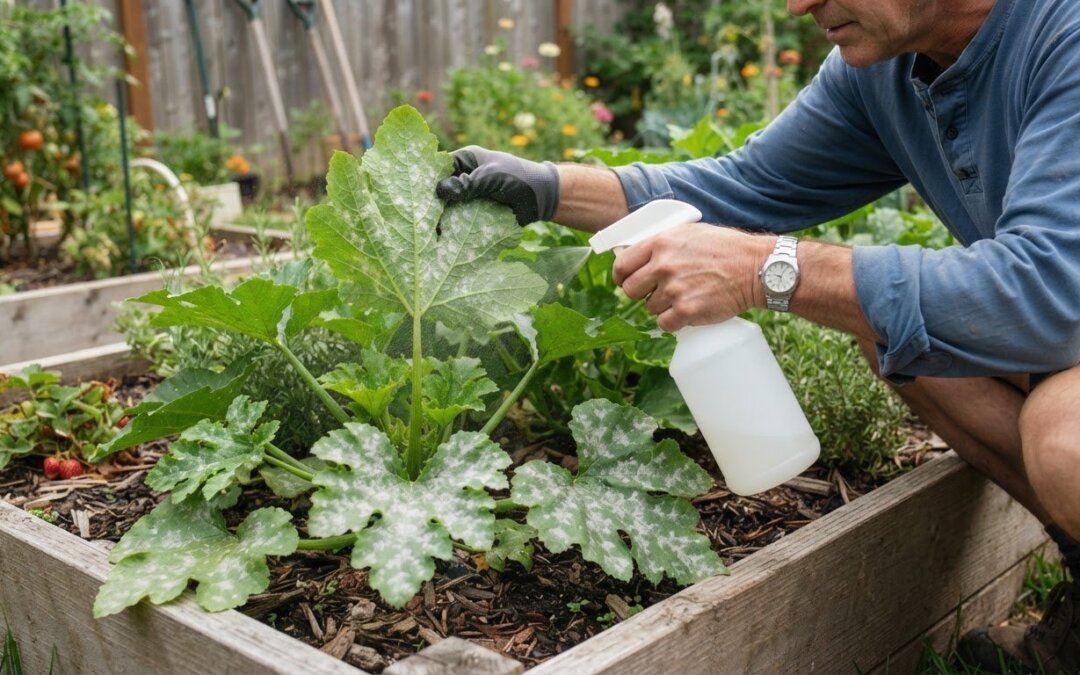
Apple cider vinegar can be used in a homemade powdery mildew spray, but it isn’t a substitute for an organic fungicide labeled for your vegetable and the disease. A commonly suggested mix is 2–3 tablespoons of apple cider vinegar in a gallon of water; the vinegar described for this spray contains 5% acetic acid.
White, powdery patches can signal powdery mildew, but identifying the problem first helps you avoid treating the wrong issue. Learn how to recognize it, choose an organic fungicide labeled for your vegetables, and check its directions for safe use. We’ll also compare milk, baking soda, and apple cider vinegar to explain what these homemade sprays may offer and where their limits matter.
Key Takeaways
- Choose a fungicide whose label names both your vegetable and powdery mildew, then follow its directions for use and safety.
- Look for powdery white patches on leaves, and inspect both the upper and lower surfaces so you can spot symptoms early.
- Milk, baking soda, and apple cider vinegar are homemade options, but their effectiveness and potential to harm plants differ.
- Apply sprays with timing and coverage in mind; for cucurbit crops, reaching the undersides of leaves matters.
1. Selecting products labeled for the plant and disease
Start with the product label, not the word “organic” on the package. Choosing an organic fungicide for powdery mildew vegetables means confirming that the label names both the disease and your vegetable. A label for cucumbers doesn’t automatically cover squash or tomatoes. Follow the directions for application, crop limits, and harvest timing. Contact treatments must reach the plant surfaces where the fungus grows.
Cucumbers, squash, and other cucurbits are common targets. The right organic fungicide for powdery mildew vegetables must be labeled for the crop and disease; no single treatment is safe for every species. Sulfur is an organic option, but it can injure cantaloupe, especially above 80°F. Avoid applying sulfur near or above 90°F, and keep oil sprays off vegetables above 90°F.
For certified organic production, check the product and its intended use against the farm’s organic plan and certifier requirements. The word “organic” alone doesn’t establish that a fungicide is suitable for that production system. For state-specific product information, consult your state pesticide regulatory agency’s registration details, then match the label to your vegetable and the disease.
Reduce infection sources, too. Remove badly affected leaves and plant debris, and dispose of them away from the garden. Powdery mildew spores can infect leaves without free water, so dry foliage doesn’t prevent disease. Moderate temperatures of 60° to 80°F and shade favor development; full sun and resistant varieties can help prevent disease.
Manage nitrogen carefully. Excess nitrogen can encourage soft, lush growth, so use soil or plant sap analysis to guide nutrient decisions rather than adding fertilizer by habit. Interpret sap results for the crop and its growth stage; they don’t diagnose powdery mildew. Before treatment, test a small area and watch for spotting or scorch. This can reveal plant damage before you treat the whole plant.
2. Is fungicide harmful to humans?
“Organic” doesn’t mean a spray is harmless to people. Risk depends on the product, exposure, and how it’s used. Read the label before mixing or applying anything, and follow its directions for protective equipment, handling, and re-entry. Keep children and pets away as directed, and avoid eating, drinking, or touching your face while handling spray. Wash your hands after application.
Harvest timing matters, too. The preharvest interval (PHI) is the label’s required wait between the last application and harvest. There isn’t one interval for every organic fungicide or vegetable, so follow the PHI on the specific product label. If the label doesn’t list your crop, don’t assume the product is suitable for it.
For prevention, begin at the first visible sign of fungal infection, or earlier when conditions favor disease and the label permits preventive use. In cucurbits, start when symptoms appear and continue weekly, following the product label. When conditions favor powdery mildew, protectant applications may need repeating at 7- to 10-day intervals as new growth develops. New tissue can emerge without a protective coating.
Coverage and timing work together. Spray leaves thoroughly, including the undersides, where powdery mildew colonies can grow. Cucurbit treatments act on contact, so missed leaf surfaces can leave infection sites untreated. Apply only at the rate and under the conditions stated on the label, and avoid drift onto nearby plants or beneficial insects. Calm conditions can help keep droplets where you intend them to go.
After application, watch plants for 2 to 3 days for visible response or leaf injury. For cucurbit powdery mildew, assess leaf severity within a week after the last fungicide application. Record the product, date, and affected plants; those notes help distinguish disease spread from treatment damage and guide the next label-compliant step.
3. Using Organic Fungicide: Do Milk Or Baking Soda Really Work?
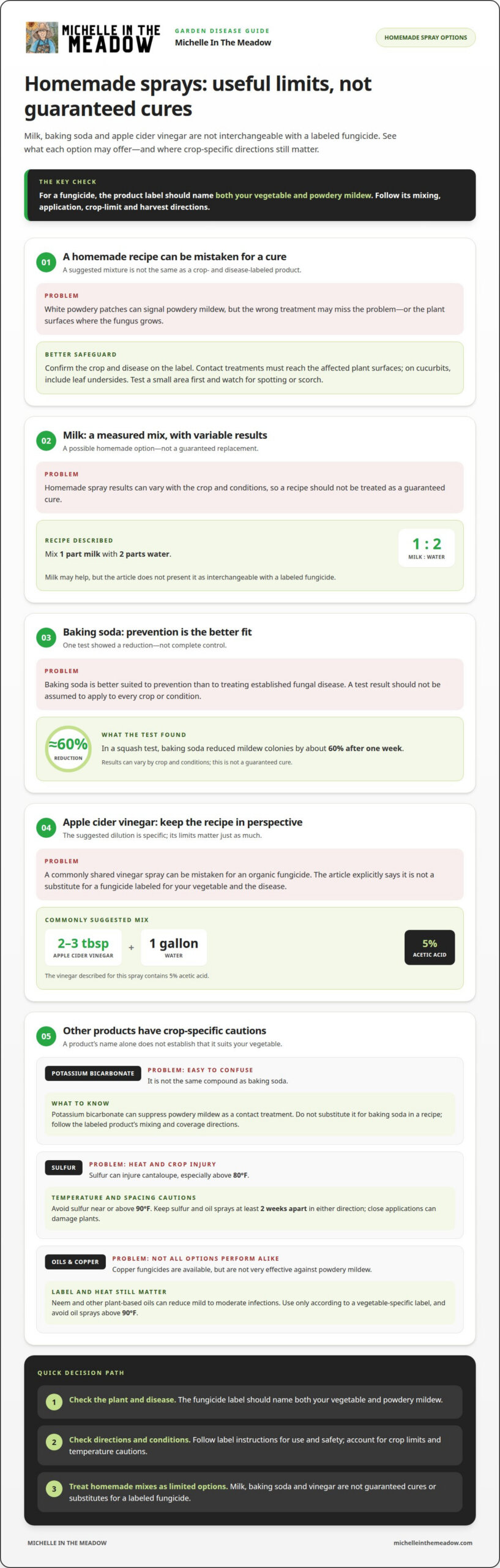
Milk and baking soda can help, but they aren’t interchangeable with a labeled fungicide. A milk spray uses 1 part milk to 2 parts water. Baking soda is better suited to prevention than treating established fungal disease. In a squash test, baking soda reduced mildew colonies by about 60% after one week. Results can vary by crop and conditions, so don’t treat a homemade recipe as a guaranteed cure.
Potassium bicarbonate can suppress powdery mildew as a contact treatment. A labeled organic fungicide for powdery mildew vegetables should name both the crop and the disease. Follow its mixing and coverage directions. Potassium bicarbonate and baking soda are different compounds, so don’t substitute one for the other in a recipe.
Sulfur is a strong organic option, especially before symptoms appear. Avoid applying it near or above 90°F; sulfur can injure cantaloupe above 80°F. Keep sulfur and oil sprays at least 2 weeks apart in either direction, since close applications can damage plants. Copper fungicides are available, but aren’t very effective against powdery mildew.
Neem oil and other plant-based oils can reduce mild to moderate infections. Apply them only according to a vegetable-specific label, and avoid oil sprays above 90°F. Tea tree oil was approved as a fungicide in 2009, but that doesn’t make every tea tree product suitable for edible crops. The label must name the crop and disease.
Aspirin and calcium magnesium citrate aren’t substitutes for labeled fungicides. Don’t assume household mixtures control powdery mildew or are safe to use on leaves. When comparing an organic fungicide for powdery mildew vegetables, consider the crop, symptoms, and temperature alongside label directions. Test a small area first, then watch for spotting or scorch before treating more plants.
4. Powdery mildew symptoms on vegetables
Look for pale, powdery patches on a vegetable’s leaf surface. They may appear on either side, then enlarge and merge across the foliage. As infection advances, affected leaves can yellow, curl, dry, or drop early. A few isolated spots are easier to miss than broad white areas, so inspect plants closely rather than waiting for the canopy to look coated.
Inspect the whole plant, not just its most visible leaves. Powdery growth can also appear on stems and leaf stalks, while nearby leaves may develop new patches as the disease spreads. Check cucumbers, squash, and other cucurbits carefully. Affected leaves may lose vigor, leaving less healthy foliage to support growing fruit.
Make inspection a repeatable garden habit. For cucurbit powdery mildew, check the upper and lower surfaces of at least 50 older leaves weekly, beginning at fruit formation. Older leaves can be easy to overlook beneath new growth. Use the same route through each bed, and note which plants show fresh spots; that helps distinguish new infection from patches you already observed.
Powdery mildew can develop in dry conditions, so dry leaves don’t rule it out. Shady growing spots and moderate temperatures can favor disease, while resistant vegetable varieties and full sun can help prevent it. Compare symptoms across plants: a single damaged leaf may have another cause, but repeated powdery patches on susceptible plants can point to a spreading fungal problem. Don’t treat every pale mark as mildew; check its texture and whether it spreads to nearby foliage.
Keep brief notes on the crop, affected leaves, and symptom changes between inspections. For more guidance on growing vegetables and recognizing garden problems, explore practical vegetable-growing guidance.
Michelle In The Meadow: Soil Calculator for Raised Beds
Michelle In The Meadow shares practical resources for gardeners planning healthy vegetable beds. The Soil Calculator for Raised Beds helps estimate how much soil a raised bed needs, while Gardening Educational Content supports informed decisions about growing conditions and garden care. Curated Gardening Product Recommendations can also help you compare supplies for your garden.
Use these resources when planning a raised bed, learning to care for vegetables, or comparing gardening products. Healthy growing conditions don’t replace accurate disease identification or following a fungicide label, but thoughtful planning can make vegetable gardening more organized.
For help taking the next step with your garden, contact Michelle In The Meadow.
Make Your Next Growing Season More Intentional
Make powdery mildew part of your garden planning, not just a problem to address after symptoms appear. When choosing an organic fungicide for powdery mildew on vegetables, consider how crop placement, growing conditions, and the product label work together. A simple plan for each bed can help you make informed decisions as plants grow and conditions change.
You don’t need to solve every garden challenge at once. Start with the vegetable bed you’re tending now, note what you want to improve, and turn to reliable educational resources as questions come up. Thoughtful planning can make your next decision more manageable, whether you’re selecting supplies or preparing a raised bed.
Visit Michelle In The Meadow to explore resources for your garden and take your next step with confidence.
Frequently Asked Questions
Is apple cider vinegar a fungicide?
Apple cider vinegar can be used in a homemade spray, but don’t rely on it as your only control for an established infection. The vinegar described for mildew sprays contains 5% acetic acid; stronger concentrations may affect mildew more but can also burn plants. If you try a homemade mix, treat a small area first and watch the leaves for damage before wider use.
Is fungicide harmful to humans?
Fungicide can pose a risk if handled or applied contrary to its label. Risk depends on the product and type of exposure, so read the directions before opening or mixing it. Review the sections on protective equipment, handling, re-entry, and harvest. Keep the label available during use and follow the instructions for that specific product rather than assuming “organic” means harmless.
Using Organic Fungicide: Do Milk Or Baking Soda Really Work?
Milk may help control powdery mildew, while baking soda is better suited to prevention than treating established disease. A suggested milk spray mixes 1 part milk with 2 parts water. One baking soda recipe uses 1 tablespoon in a gallon of water. Apply homemade sprays sparingly, test a few leaves first, and don’t treat these kitchen mixtures as equivalent to a crop-labeled fungicide.
What is the best time to apply fungicide?
Apply a suitable product at the first visible sign of infection, or preventively when conditions favor disease and the label allows it. For cucurbits, applications should begin when symptoms appear and continue weekly, following label directions. Choose a time when you can coat the leaf surfaces targeted by the product. Avoid conditions the label warns against, and record each application.
Which organic fungicides are effective against powdery mildew on vegetables?
Sulfur is a leading organic option, particularly as a preventive spray before symptoms appear. Horticultural and plant-based oils, including neem, can reduce mild to moderate infections. For cucurbits, using two biopesticide products with different modes of action is a recommended strategy. Whichever type you consider, effectiveness depends on choosing a label that names both the vegetable and powdery mildew.
How do neem oil and horticultural oils compare for treating powdery mildew on vegetables?
Neem oil is one plant-based oil; horticultural oil describes a broader treatment category. Both may help reduce mild to moderate powdery mildew, but neither should be treated as a cure for every crop or infection. Oil sprays can injure vegetables in hot conditions, so avoid applying them above 90°F. Compare crop-specific labels, and don’t combine oil timing with sulfur applications.