
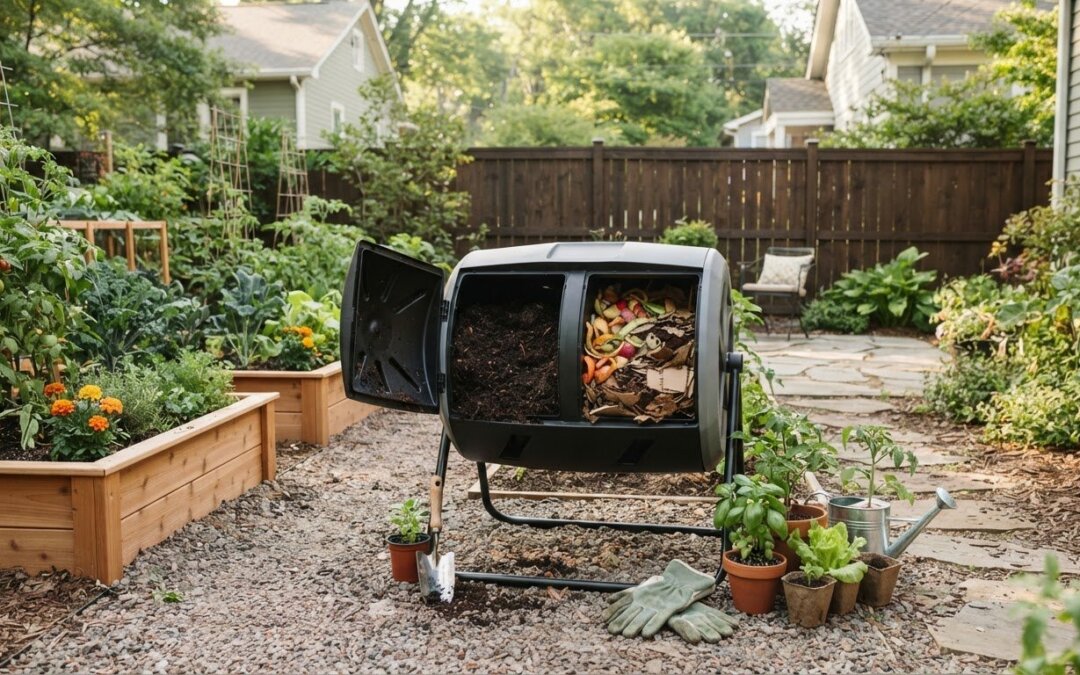
The best compost tumbler for small yards is usually a dual-chamber model, especially if you want to keep adding scraps while a separate batch finishes. For one or two people composting mostly kitchen scraps, a capacity of 18 to 25 gallons is a practical fit; a family of four adding garden or small-lawn waste may need 37 to 43 gallons across two chambers.
A compact tumbler can make composting feel manageable, but capacity is only part of choosing the best compost tumbler for small yards. Consider how easily it turns, where it will sit, and how you’ll balance the mix as you add scraps.
This guide compares six options for small yards and helps you match a tumbler’s size and design to the material your household produces. You’ll also learn how to start and use a tumbler, what to expect from composting, and how to use finished compost, so your choice works beyond the first batch.
Key Takeaways
- Match the tumbler’s chamber setup to how often you add scraps and whether you want to keep batches separate.
- Compare access, turning effort, stability, and how well the design contains compost before choosing a spot in your yard.
- Balance moist kitchen scraps with dry browns, and keep the mix damp rather than soggy to support composting.
- Plan where finished compost will go, from garden beds and containers to a larger compost pile for material that needs more time.
- Use the Soil Calculator for Raised Beds to estimate how much soil your raised bed needs when you’re ready to put finished compost to work.
Where does the finished compost go?
A properly managed tumbler can produce compost in 4 to 8 weeks in summer, but tumblers often work slowly. Moisture, the balance of green and brown material, turning, and temperature all affect how quickly scraps break down.
Check the texture before using a batch: finished compost is dark and crumbly, with the original scraps no longer recognizable. If you still see distinct food pieces or fresh clippings, give it more time. Actively managed compost can take several months to form, while unattended compost can take as long as three years.
Use finished compost where it can support the soil, rather than expecting every tumbler batch to be ready at once. Blend mature compost into raised-bed soil before planting or spread it on the surface to refresh the bed. For containers, mix it with potting medium rather than filling a pot with pure compost. A thin layer around established plants also adds organic matter as it breaks down.
A small tumbler may release a partly processed batch before it is ready for garden use. A turned hot pile can finish that material, but it needs at least 1 cu yd of compost to retain heat for hot composting. If your yard cannot hold a pile that size, let the tumbler batch continue breaking down or use it as a surface layer away from plant stems.
Choose where to use the compost based on its condition and the space you have:
| Option | Best fit | Practical use |
|---|---|---|
| Raised beds | Dark, crumbly compost | Blend into bed soil or top-dress |
| Containers | Mature, screened compost | Mix with potting medium |
| Turned hot pile | Partly processed material | Finish in a pile holding at least 1 cu yd |
| Garden surface | Partly broken-down scraps | Apply as a thin layer around plants |
Check whether the compost has fully broken down and whether your yard has room for a hot pile before choosing its destination.
Make unloading and maintenance part of the routine. Open the tumbler’s access door over a tarp or garden cart, then sift out coarse pieces and return them to the chamber. Keep the mix near 50 to 60% moisture by weight, roughly like a wrung-out sponge, and add dry leaves or straw when wet kitchen scraps make it soggy. Keep a balance of green and brown materials, and turn the tumbler regularly to help air move through the batch.
What is the best compost tumbler?
For a small yard, compare how batches move through the system, how much material it holds, and how easy it is to access. A tumbler suits contained batches that you turn regularly; a stationary bin or open pile may suit a different routine or yard layout.
Dual-Chamber Tumblers
A dual-chamber tumbler lets one batch finish while you add fresh scraps to the other. That separation is useful when kitchen waste arrives steadily, because new material won’t interrupt an older batch. Many spinning compost bins have two chambers for starting batches at different times. Smaller two-chamber tumblers may not retain heat in winter unless they’re double-walled, so weigh seasonal conditions alongside convenience.
Single-Chamber Tumblers
A single-chamber tumbler holds one batch, so you generally add material until it’s full, then let that batch finish before loading again. That makes it a straightforward choice if your household produces scraps in manageable amounts or you don’t need continuous access. A 30- to 60-gallon single-chamber tumbler shouldn’t be continuously refilled. Compared with two chambers, it offers fewer options for keeping fresh scraps separate from compost already breaking down.
Rotating Barrels and Box-Style Bins
Rotating barrels contain compost in a closed drum that turns for mixing; box-style bins stay in place and are loaded from above or through an opening. Barrel-style bins typically hold 22 to 65 gallons, while box-style bins range from about 60 to 120 gallons. A waist-high vertical tumbler can be harder to turn because its position creates a mechanical disadvantage. Ground-based rolling models can suit a yard if their plastic is thick and stable in sunlight.
A tumbler is enclosed, and raised models keep animals out, but they don’t exclude insects. A stationary bin or open pile offers a different setup, with material accessed from the top or sides rather than through a rotating drum. Metal parts can rust; plastic barrels avoid rust but still need sturdy supports and turning mechanisms. Local placement rules, including city and homeowners association requirements, can also affect which design suits your yard.
Ease of Turning, Loading, and Unloading
For easier turning, look for a stable base and sturdy turning mechanisms, then consider how the barrel sits within your reach. A high vertical barrel can be awkward to rotate, while a ground-based roller moves along the ground. Loading depends on the access door: a wide opening makes it easier to add leaves or kitchen scraps without spilling. Leave room to open the door, rotate or roll the tumbler, and position a cart for unloading. That clearance matters in a narrow yard or beside a fence.
For a practical comparison, consider how you’ll use the finished batch: a tumbler keeps material contained, while a larger stationary bin or compost pile accommodates a different scale of handling. Explore practical composting guidance as you decide which routine fits your garden.
How tumblers aerate and contain compost
A compost tumbler aerates material as it moves: turning rolls scraps and dry browns together, helping air reach more surfaces. Unlike an open garden pile, its enclosed drum contains loose leaves and food scraps. Turning alone won’t fix an imbalanced mix, though. Wet kitchen waste can still clump, while dry cardboard may remain unmixed.
Moisture affects both airflow and decomposition. Aim for 50 to 60% moisture by weight, with a texture like a wrung-out sponge. If a handful drips, add dry leaves or torn cardboard; if it feels dusty, add water gradually. Food scraps and grass clippings carry plenty of water, so a tumbler heavy with those materials may release dark liquid. Place it where runoff won’t stain a patio or flow toward a path.
Build a balanced batch from greens and browns. Kitchen scraps and fresh clippings supply green material; dry leaves, straw, and torn cardboard add browns. Compost should contain roughly equal amounts of each, with a carbon-to-nitrogen ratio of 25:1 to 30:1. Add a layer of browns after wet scraps, then turn the chamber to blend them. That simple sequence can reduce soggy pockets and improve air movement.
Use turning as the tumbler’s main aeration step. Rotate it every 2 to 3 days, especially after adding a load of kitchen waste. A rotating chamber mixes material without requiring a fork to lift and loosen the pile. Check the contents through the access door: compacted scraps need more dry structure, while loose, dry pieces may need a little water. The target remains a wrung-out-sponge feel throughout the process.
Temperature helps explain why a tumbler may not behave like a hot compost pile. Tumblers generally operate at 70 to 110 F, below the thermophilic range of 130 to 160 F. That means turning can distribute air and material, but it doesn’t ensure hot-pile temperatures. In spring, when garden cleanup adds leaves and stems, balance those additions with kitchen greens rather than filling the drum with one material.
An enclosed tumbler keeps scraps together and makes daily handling tidy, but it isn’t a sealed barrier against every pest. Models raised off the ground keep animals out, but not insects. Secure doors and latches to keep rats, possums, and raccoons from getting inside. Check the supports and turning parts during routine use, and look for leaks, loose fasteners, or material caught around the opening.
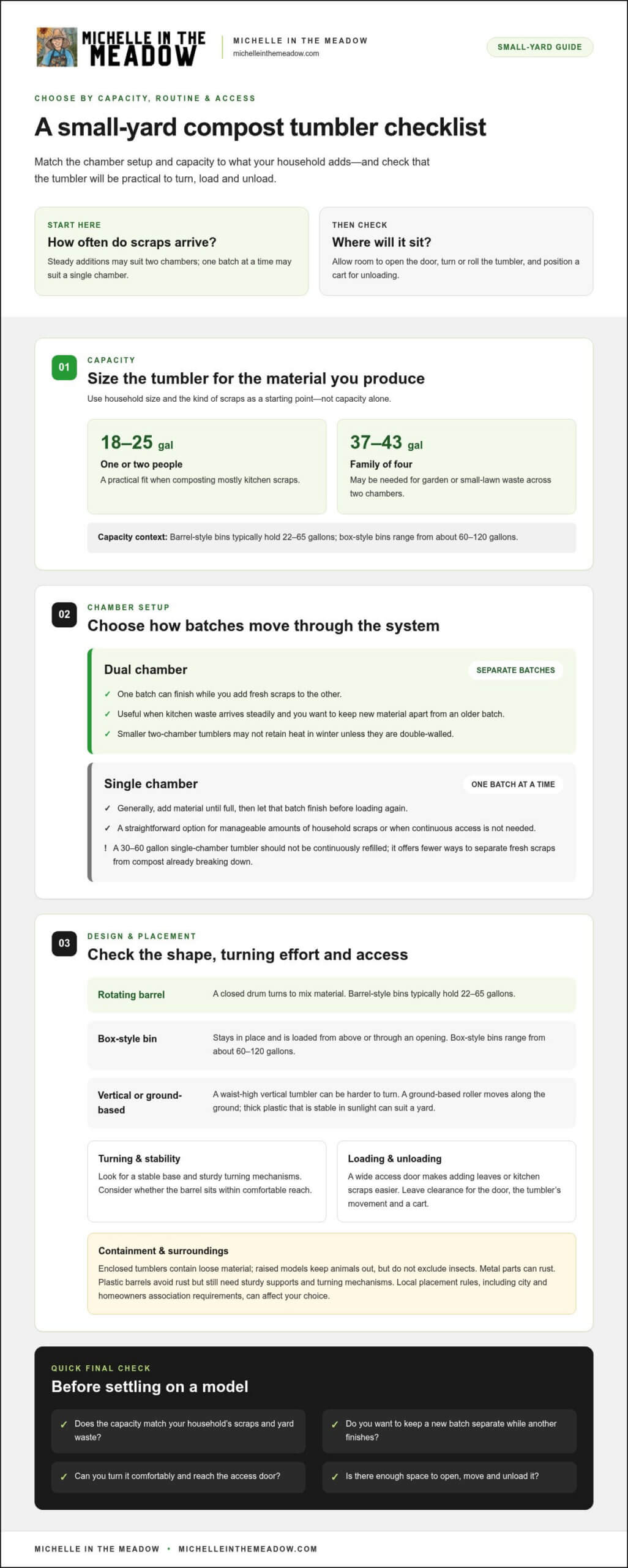
Tumbler capacity for household and yard waste
Choose a tumbler size based on the material your household produces, not just the space available. A useful starting point is enough capacity for roughly two months of scraps and yard waste.
Capacity and Batch Management
For one or two people composting kitchen scraps with little or no yard waste, 18 to 25 gallons is a practical capacity. A family of four adding garden material or small-lawn waste may need 37 to 43 gallons split across two chambers. These sizes help match capacity to incoming material rather than leaving a small drum overflowing with leaves each fall.
Think about batch rhythm, too. A single chamber holds one batch, while two chambers let you add fresh material separately as an older batch finishes. A 30- to 60-gallon single-chamber tumbler shouldn’t be continuously refilled. Choose room for your household’s regular scraps, then account for seasonal yard waste that can quickly fill available space.
Compost Bin Capacities and Prices
Compost tumblers commonly range from 5 to 15 cubic feet, with barrel-style models typically holding 22 to 65 gallons. Enclosed stationary bins are listed at 7 to 15 cubic feet, while box-style bins range from about 60 to 120 gallons. Compare like units carefully: gallons and cubic feet describe volume differently, and advertised capacity doesn’t tell you how much room leaves occupy.
Spinning bins compared by the author cost about twice as much as a simple box-style bin. Treat these as broad product-category ranges, not a guarantee of a particular model’s price. Design and construction affect the price you’ll find.
For a small yard, match capacity to your household scraps and the seasonal material you can actually store. Dry leaves can take up considerable room before they break down, so keep them nearby as browns without letting them crowd the tumbler. If most of your input comes from the kitchen, a smaller chamber may suit you better than a large bin intended for regular lawn clippings.
Winter changes the capacity decision in colder regions. Standard thin-walled tumblers can lose 4 to 5 months of processing each year in cold climates and can stall completely below freezing. Gardeners in USDA zones 3 to 5 should consider an insulated bin or a large insulated pile for year-round processing. Small two-chamber tumblers may not insulate themselves unless double-walled.
Choose the smallest capacity that comfortably holds about two months of your usual material, then plan separately for leaves and slower winter composting.
Starting and using a compost tumbler
A useful routine starts with balanced ingredients, not a full barrel of kitchen scraps. Combine green material, such as food waste, with brown material, such as dry leaves or straw. Compost should contain roughly equal amounts of greens and browns, with a carbon-to-nitrogen ratio of 25:1 to 30:1. Add browns as you go, especially after wet scraps or grass clippings.
Use this simple sequence whenever you start a batch:
- Add a base layer. Put dry leaves, straw, or torn cardboard into the chamber before adding food scraps.
- Mix in fresh material. Add kitchen waste, then cover it with more browns to absorb liquid and reduce exposed scraps.
- Check moisture. Keep the mix at 50 to 60% moisture by weight, similar to a wrung-out sponge. Add dry browns if it feels soggy, or water gradually if it feels dry.
- Close and turn. Secure the door and rotate the tumbler every 2 to 3 days.
Turning mixes the material and brings air through the batch, but it won’t correct excess moisture by itself. Food scraps and grass clippings contain plenty of water, and a tumbler can leak dark liquid when they dominate the mix. If liquid appears, add dry leaves or straw, then turn the barrel to distribute them. Secure the tumbler so rats, possums, and raccoons can’t get inside.
Keep a 30- to 60-gallon single-chamber tumbler closed to new additions once full. Let that batch finish before adding more material. With two chambers, start a fresh batch in one side while the other continues processing. This simple separation helps prevent newly added scraps from mixing into compost that’s nearly ready.
Turning frequency and seasonal warmth affect the pace. A properly managed tumbler can produce compost in 4 to 8 weeks during summer, while actively managed compost can take several months. Temperature, moisture, the mix of greens and browns, and regular turning all influence the timeline. Check texture and recognizable scraps before using the material, rather than relying on the calendar alone.
Red wigglers can also feed on decomposing waste in a tumbler, enriching finished compost with castings. If you’re learning how to balance batches for garden use, explore composting guidance for home gardeners and apply the steps to your own routine.
Michelle In The Meadow: Soil Calculator for Raised Beds
Michelle In The Meadow’s Soil Calculator for Raised Beds helps you plan the soil volume for a raised bed, a useful next step when deciding where finished compost will go. Enter the bed’s dimensions to estimate its soil needs and plan how compost fits into your garden project.
For practical guidance beyond bed planning, Michelle In The Meadow also shares gardening educational content and curated gardening product recommendations. Use these resources as you move from choosing and using a tumbler to preparing a growing space for finished compost.
Visit michelleinthemeadow.com to explore the soil calculator and gardening guidance.
Make your next garden decision a practical one
Choosing the best compost tumbler for small yards is a step toward putting food scraps and garden leftovers to use. Next, decide where the finished compost will go. A bed, container garden, or planting area can each shape how you use it and prepare the soil.
Start with a manageable composting routine, then notice what your household adds and where the finished material fits. That experience can guide future adjustments without requiring you to redesign the whole yard at once. If you’re planning a raised bed, Michelle In The Meadow’s Soil Calculator for Raised Beds can help you plan the growing space.
Explore Michelle In The Meadow’s gardening resources and take the next step toward a garden that makes good use of what you grow and compost.
Frequently Asked Questions
What are the best compost tumblers for small yards in 2026?
For a small yard in 2026, a compact dual-chamber tumbler is a strong fit for households that add scraps regularly. Separate chambers let you start a new batch without mixing fresh kitchen waste into older material. If you compost mostly for one or two people, consider a smaller capacity; households adding garden clippings need more room. Prioritize sturdy supports, manageable turning, and an opening that makes loading and emptying practical.
How much do small-yard compost tumblers cost in the United States?
These are broad category ranges, not a quote for a specific model. Construction, chamber design, and capacity can affect the price. Compare those details with the purchase cost: a less expensive tumbler may not suit your yard if it’s difficult to turn or access.
What capacity compost tumbler is best for a small yard or household?
For one or two people who compost kitchen scraps and little yard waste, 18 to 25 gallons is a useful starting range. A family of four adding garden or small-lawn waste may want 37 to 43 gallons across two chambers. Think about seasonal inputs, too: a household that saves autumn leaves needs room to store browns separately. The right capacity depends on what you’ll actually add and how often.
How do dual-chamber and single-chamber compost tumblers compare?
A dual-chamber tumbler separates batches, so you can add fresh scraps to one side while older material breaks down in the other. A single-chamber model keeps the routine simpler, but you’ll need to stop adding material to a full batch while it finishes. Separate chambers can make batch timing easier if kitchen scraps arrive steadily. For occasional additions, one chamber may be enough.
How do you use a compost tumbler, including the right mix of greens and browns?
Layer green scraps, such as vegetable trimmings, with brown material like dry leaves or torn cardboard. Aim for roughly equal amounts of greens and browns, then adjust if the mixture becomes soggy or dry. Close the access door securely and turn the tumbler every 2 to 3 days. Cut bulky scraps into smaller pieces to help them mix evenly, and keep a covered container nearby for kitchen scraps between turns.
What should you avoid putting in a backyard compost tumbler?
Keep meat, fish, bones, dairy, and oily or greasy leftovers out of a small backyard tumbler. These materials can create odors or attract animals if the system isn’t designed to handle them. Also avoid pet waste, charcoal ash, and plants treated with persistent herbicides. Stick with fruit and vegetable scraps, coffee grounds, plain paper, and garden trimmings. If you’re unsure about a material, leave it out of the batch.
Which compost tumblers resist rust, pests, and weather best?
Plastic barrels avoid rust, and ground-based rolling models may suit a yard if the plastic is thick and stable in sunlight. Raised tumblers keep animals out, but not insects. Secure doors and latches to keep larger pests from getting inside.
