
What if the best companion planting plan isn’t a perfect-pair chart at all? One guide may recommend a pairing while another warns against it, and your garden bed may already be getting crowded. It’s reasonable to wonder which advice to trust, especially when pest-control claims sound like guarantees.
The useful idea is simpler: some plants can support one another through practical, observable effects, but no pairing fixes every garden problem. Flowers such as sweet alyssum can attract beneficial insects, while aromatic herbs may make it harder for some pests to find a crop. Other popular claims aren’t well supported, so it helps to separate evidence from garden folklore.
This guide will help you choose combinations that fit your conditions, plan spacing and timing, and adjust pairings as the season changes. We’ll look at how plants share space, light, water, and nutrients, and at the mechanisms that can make certain combinations useful. You’ll come away with a flexible plan that leaves room for airflow, watering, and harvesting, while treating companion planting as one helpful tool rather than a guaranteed fix.
Key Takeaways
- Think about growth habits, timing, and shared resources, not just which crops appear together on a chart.
- Compare possible companion planting pairings by their purpose, spacing needs, and fit with your garden conditions.
- Plan a bed by listing crops, checking their needs, sketching mature spacing, sequencing planting, and reviewing results.
- Account for your climate, available light, growing season, and planting calendar before settling on a combination.
- If a pairing struggles, check plant health and growing conditions first. Crowding, mismatched needs, and timing can all affect results.
What Is Companion Planting, and What Can It Realistically Do?
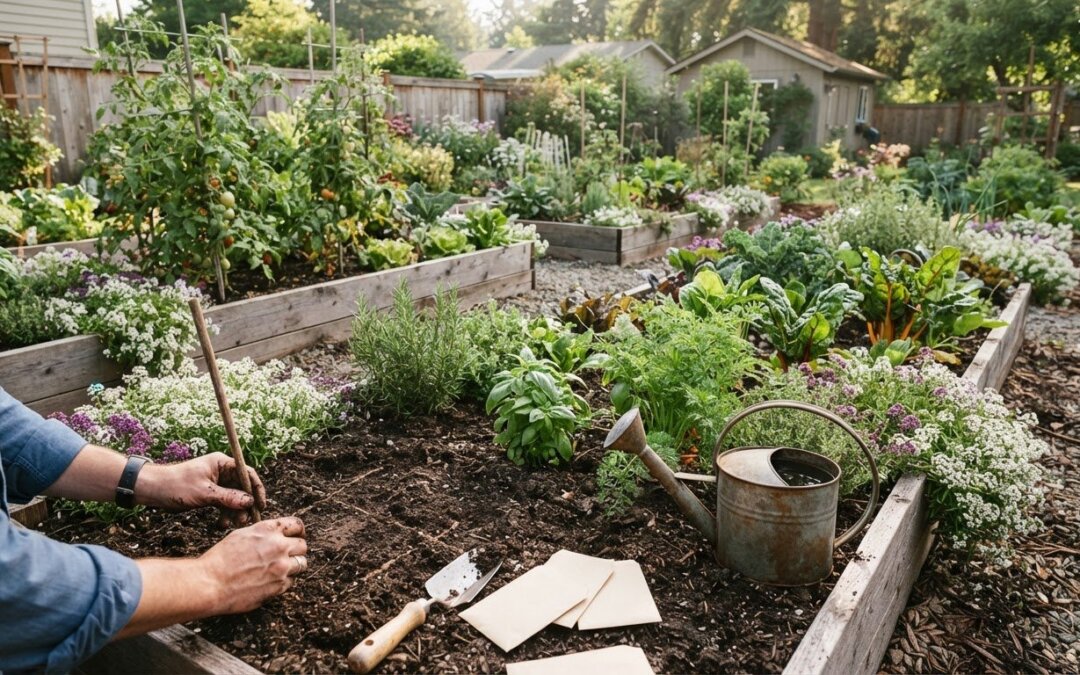
Companion planting means intentionally growing different plants near one another to meet practical garden goals. Those goals might include making better use of a small bed, spreading harvests across the season, adding variety, or creating habitat for beneficial organisms. The key word is intentionally: a planned combination accounts for each plant’s mature size, light and water needs, and growing schedule. Mixing crops without considering those needs can create competition instead of a helpful partnership.
Think of companion planting as one way to organize a garden, not a recipe for guaranteed results. The Wikipedia article on companion planting provides a broad overview of its history and commonly discussed pairings, but a pairing’s usefulness still depends on how it fits your growing conditions.
Why gardeners grow plants together
Plants can complement one another through their height, rooting patterns, and timing. For instance, quick-growing leafy crops may use open ground between slower-growing plants early in the season, before the larger plants spread. That arrangement helps only if each crop still has enough room and access to light, water, and nutrients as it matures.
Flowering plants can provide food or shelter for beneficial insects, including species that prey on garden pests. A varied planting may also make a bed less uniform and sometimes disrupt a pest’s ability to find its preferred crop. These are possible benefits, not reliable pest-control promises. Notice which insects visit and whether the plants are thriving instead of assuming every nearby flower will protect a vegetable.
What companion planting cannot promise
A familiar pairing isn’t proof that one plant will improve the other’s growth or prevent damage. Some recommendations come from tradition or are repeated without consistent support. Even when a proposed mechanism makes sense, such as scent masking a crop, its effect can depend on the pest, plant variety, weather, and garden layout. Treat confident claims with care, especially if they suggest one pairing will solve a pest problem by itself.
Compatible plants still compete when space, light, or water is limited. A vigorous neighbor can shade a smaller crop, and closely planted roots may draw on the same soil resources. Start with healthy soil and attentive care, then try a pairing in a manageable area. Note what you planted, where it grew, and how both crops performed. Those observations help you judge what works in your garden without expecting one combination to guarantee a larger harvest or trouble-free plants.
How Plant Pairings Work: Space, Timing, and Garden Relationships
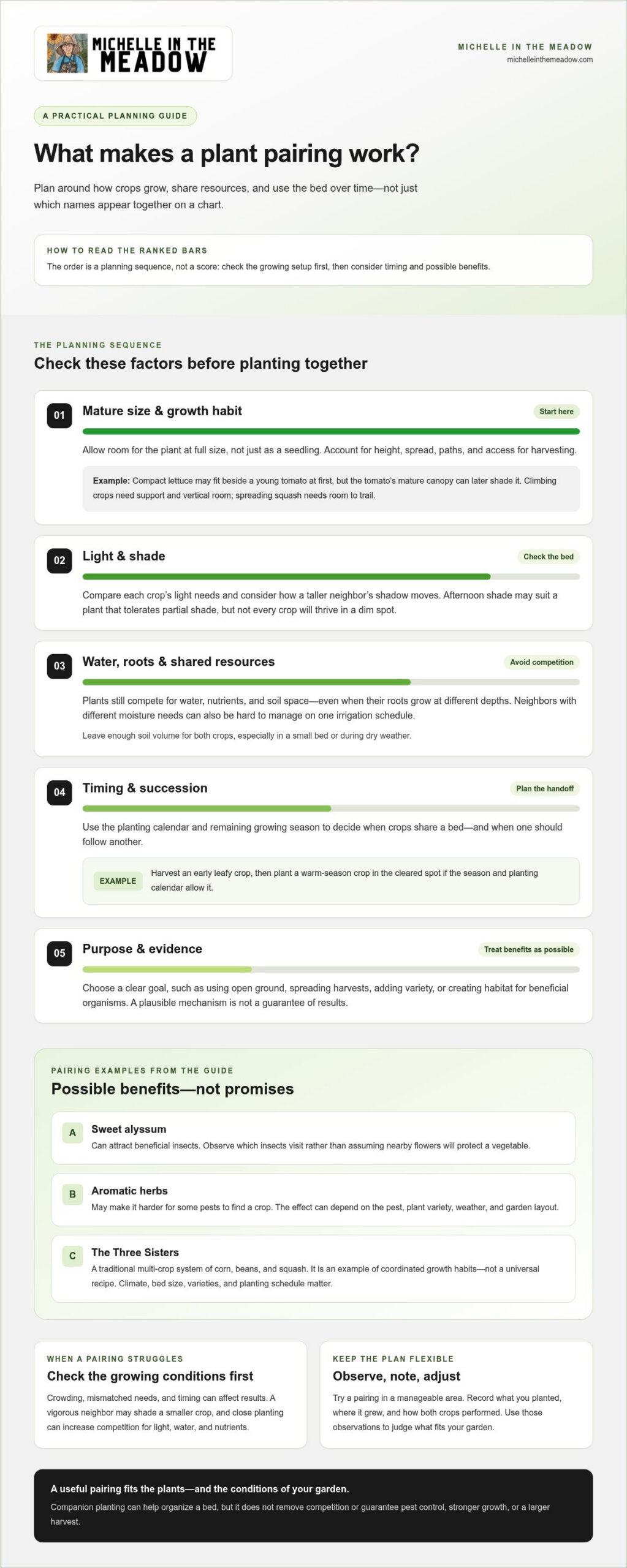
Good pairings begin with each crop’s shape and schedule, not a fixed rule about which plants belong together. Companion planting is the intentional arrangement of different plants so their growth habits, timing, or habitat needs can work well side by side. That can help you use a bed thoughtfully, but it doesn’t remove competition for sunlight, water, or nutrients. Different root depths may reduce overlap in some situations, yet roots still draw from the same soil and need room to grow.
Match plants by their growing habits
Look beyond seedling size. Compact lettuce may fit beside a young tomato early in the season, but the tomato’s mature canopy can later shade it. A climbing crop needs sturdy support and vertical room; spreading squash needs space to trail without covering its neighbors. These forms can share a bed if the layout allows for mature growth and keeps paths accessible.
Sunlight matters as much as shape. A taller crop may cast useful afternoon shade on a plant that tolerates partial shade, but that doesn’t mean any shade-tolerant crop will thrive in a dim corner. Check each plant’s light needs and watch how shadows move across the bed. Consider watering, too: neighbors with different moisture needs can be difficult to manage if they share one irrigation schedule.
Root depth can inform a plan, but it doesn’t create separate resource zones. A shallow-rooted crop and a deeper-rooted crop may still compete for water and nutrients, especially in a small bed or during dry weather. Leave enough soil volume for both, rather than squeezing plants together because you expect their roots to grow at different depths.
Use timing and diversity thoughtfully
Timing can free up space. With succession planting, you sow or transplant a later crop after an earlier one has finished, rather than keeping both in the bed at once. For example, once an early leafy crop is harvested, you might plant a warm-season crop in the cleared spot if the remaining growing season and planting calendar allow it. This handoff avoids crowding while making productive use of the bed over time.
The Three Sisters is a coordinated system of corn, beans, and squash, often discussed as a traditional multi-crop planting. It’s a useful example of plants arranged with different growth habits, but it isn’t a universal recipe. Climate, bed size, varieties, and planting schedule all affect whether the arrangement fits. Michigan State University Extension’s guide to companion planting discusses the system alongside practical planting considerations.
For a raised-bed layout, the raised-bed soil calculator can help estimate how much soil the bed needs before planting.
Which Companion Plants Make Sense Together? Compare Pairings by Purpose
Start with a specific garden goal: making room for an early crop, adding flowers for insects, or growing familiar ingredients close together. The examples below are possibilities, not guaranteed partnerships. Before choosing one, compare each plant’s mature size, light and water needs, and timing with the conditions in your bed. Utah State University Extension’s explanation of companion planting offers broader context on how plant diversity can contribute to a balanced garden.
| Pairing | Possible purpose | Spacing caveat | Conditions to check |
|---|---|---|---|
| Tomato and basil | Grow two useful warm-season crops together for harvest variety. | Both need room as they mature; don’t let basil crowd the tomato’s base. | Sunlight, watering needs, mature plant size, and airflow. |
| Leaf lettuce and a slower-growing tall crop | Harvest an early crop before the neighboring canopy fills out. | Leave enough room to lift or cut lettuce without disturbing nearby roots. | Whether the lettuce will be ready before it’s heavily shaded. |
| Sweet alyssum and vegetables | Add flowers that may offer food and habitat for beneficial insects. | Keep flowering plants from taking over paths or shading low crops. | Flowering period, light, water, and space at mature size. |
| Corn, beans, and squash | Arrange crops with upright, climbing, and spreading growth habits. | Allow room for the corn grouping, climbing beans, and spreading squash. | Climate, varieties, support structure, and planting sequence. |
Pairings for efficient space and staggered harvests
A compact crop can make temporary use of open ground beside a slower-growing neighbor, provided you can harvest it before crowding becomes a problem. For example, sow leaf lettuce near a young, upright crop and plan to pick it while it still has room and light. Cut or lift it carefully to avoid damaging the neighboring plant’s roots or stems. If the plants need different watering or light conditions, the space-saving arrangement may not be worth the extra care.
The Three Sisters is a specific system, not a universal template: corn forms the upright structure, beans climb it, and squash spreads across the ground. The plants need coordinated spacing and timing so the corn is established enough to support the beans and the squash has room to spread. The details depend on varieties and garden conditions, so don’t treat this arrangement as a plug-in formula for every bed.
Pairings for flowers, herbs, and garden diversity
Flowering companions can bring pollinators and other beneficial insects into a garden, but that habitat value doesn’t mean flowers reliably repel pests. Herbs need the same practical check as vegetables. Basil, for instance, should share a spot only with plants whose sunlight, water, and mature spacing needs it can tolerate.
That’s a steadier basis for companion planting than a chart promising that one plant will protect another. Favor pairings that fit your growing conditions, and treat any added benefit as something to observe rather than assume.
How to Plan a Companion-Planting Bed in Five Practical Steps
A workable plan starts with the garden you have, not a chart’s idealized layout. Before choosing combinations, consider your climate, the season, available light, and planting calendar. Then use this sequence to plan a bed you can reach, water, and harvest comfortably.
- List the crops. Write down what you hope to grow, including flowers and herbs. Note which crops are priorities, which can be harvested early, and which need support or room to spread.
- Note each plant’s needs. Check seed-packet guidance and other reliable growing information for light, water, planting time, and expected mature dimensions. A seedling’s small footprint can be misleading, so plan for its full-grown leaves, stems, and roots.
- Sketch mature spacing. Draw the bed to scale and mark where each plant will fit at maturity. Include paths or access points so you can reach the center without stepping on the soil or brushing against neighboring crops.
- Sequence the planting. Add crops in a sensible order based on the planting calendar and how long each needs to grow. If an early crop will be harvested before a later one fills out, show that change on the plan rather than squeezing both into the same space all season.
- Review the results. During the season, note what thrived, what became crowded, and whether watering or harvesting felt awkward. Use those observations to adjust the next layout.
Sketch a realistic garden layout
Record the bed dimensions, patterns of sunlight, nearby structures, and where you’ll stand to tend the plants. Consider how a fence, wall, or trellis changes light and airflow. Place tall crops where they won’t unintentionally shade sun-loving neighbors, taking the sun’s direction and seasonal light into account. Keep the drawing flexible. A sketch helps you spot potential conflicts, but it shouldn’t lock you into a layout if conditions or crop choices change.
For raised beds, mark the actual inside dimensions and account for the space occupied by supports. If you’re estimating soil for a new or refreshed bed, use the raised-bed soil calculator as part of your planning.
Plant, observe, and adjust
Keep a simple garden record of planting dates, spacing, growth, harvests, and noticeable pest activity. A quick note after watering or harvesting is often enough. If plants struggle, record conditions such as shade or dry soil so you don’t mistake a growing problem for a bad pairing.
Next season, change one or two variables, such as spacing or planting timing, and keep the rest similar. That makes it easier to judge which adjustment may have helped. Michelle In The Meadow’s garden-planning resources can help you turn those notes into a more useful plan.
Troubleshoot Companion Planting and Build a Garden Plan That Improves
A struggling plant doesn’t automatically mean its neighbor is a poor match. Crowding, inconsistent watering, limited light, and seasonal weather can all affect growth. Before changing a pairing, look at the whole bed and the plants’ current conditions. Careful observation can keep you from removing a useful crop or repeating the same layout problem next season.
What to check when a pairing struggles
Start with what you can see. Has a larger plant grown over a smaller one? Are leaves so dense that air can’t move easily? Does the soil dry quickly near one crop while it stays wet near another? Roots at different depths may still compete for water and nutrients, particularly in a confined bed.
Compare the plants’ current size with your original sketch. A layout that looked spacious when seedlings were small may become crowded as leaves spread or stems climb. Consider whether the neighbors need different amounts of sun or water, too. If one plant is stressed, check for signs of watering problems, damage, or disease before concluding that the pairing caused it.
Pest activity takes careful interpretation. If you notice fewer pests near a companion plant, record it, but one observation doesn’t prove the plant kept them away. Weather, crop growth, and the timing of pest activity may also have changed. Treat companion planting as one part of diverse, attentive garden care, not a replacement for regular monitoring or appropriate pest management.
Choose tools and resources for the next planting
You don’t need special equipment to learn from a garden. A notebook, weatherproof labels, or a simple layout sketch can help you keep track of what happened and where. Record:
- Planting dates and approximate spacing.
- How each crop grew as it reached mature size.
- Harvests, noticeable pest activity, and any plant stress.
- Changes in light, watering, or care that might explain the result.
At the end of the growing season, keep combinations that fit your space and care routine, revise the ones that became difficult to manage, and note why you’re making each change. Adjust one or two things at a time next season so you can learn from the comparison. A wider gap, a shifted planting date, or moving a tall crop may be more useful than replacing the whole plan.
Good gardening is an ongoing process, not a test you pass on the first try. Explore practical gardening resources as you plan your next round of planting and observation.
Let Your Garden Teach You What Works
Your next bed doesn’t need a perfect pairing chart. Choose one combination that fits your space and growing season, then give yourself room to notice how it develops. A few brief notes can turn this season’s surprises into a more thoughtful plan next time. That’s the steady, satisfying side of companion planting: learning from the garden you actually have.
Michelle In The Meadow shares approachable gardening guidance through blog posts and videos. For raised-bed projects, its soil calculator can help you plan how much soil your bed needs. Use these resources alongside your own observations, and keep adapting as your garden changes.
Explore Michelle In The Meadow’s gardening guides and raised-bed soil calculator to plan your next planting.
Frequently Asked Questions
Does companion planting really work for a home garden?
It can be useful, but results depend on the plants and conditions rather than the pairing name alone. Flowers may provide food for beneficial insects, and a thoughtfully arranged bed can make better use of space. Those effects don’t guarantee fewer pests or bigger harvests. Try one manageable combination, observe how it grows, and compare it with the rest of your garden before deciding whether it helped.
Can I use companion planting in containers or small raised beds?
Yes, as long as each plant has enough room and the container can meet their shared needs. A large vegetable paired with several neighbors may quickly use up the available space, soil moisture, or nutrients. Try one main crop with a compact companion, and check the mature size of both before planting. Containers can dry at a different pace than garden beds, so watch moisture as the plants grow.
Do tomatoes and basil need to be planted next to each other?
No. Tomatoes and basil can grow in the same garden, but they don’t have to be neighbors for you to harvest both. Give each plant suitable light, water, and room to mature, and leave enough space to reach the tomato for pruning or picking. If you plant them close together, treat it as a convenient layout choice, not a requirement or a promise of improved growth.
What flowers can I grow near vegetables to attract beneficial insects?
Sweet alyssum is one option: its nectar and pollen can feed beneficial insects such as hoverflies, lacewings, and parasitic wasps. Choose a spot where the flowers receive suitable light and won’t crowd vegetable leaves or block access for harvesting. Flowering plants support habitat, but they won’t attract every helpful insect in every garden. Notice which visitors arrive and whether the flowers bloom while your vegetables are growing.
Can companion planting replace other pest-management methods?
No. Use companion planting as one part of ongoing pest management, not as a stand-alone fix. Check plants regularly for early signs of damage, identify the pest before acting, and keep the bed healthy with suitable watering and airflow. A nearby flower or herb may support beneficial organisms, but it can’t guarantee that pests won’t appear. Respond to what you observe rather than relying on a pairing chart alone.
How close should companion plants be planted?
Follow the spacing guidance for each crop and plan around mature width, not the small size of seedlings. If the recommended spacing leaves no room for a companion, don’t force both into the same patch. Keep access for watering, harvesting, and checking leaves, and account for supports or paths that take up bed space. In containers, pay particular attention to root room and how quickly the soil dries.
When should I change a companion-planting combination that is not working?
Change it when your observations point to a persistent problem, such as one plant repeatedly shading another or the two needing incompatible watering. First check for other causes, including weather, soil moisture, and plant health. Adjust the layout during the season if practical, or make a note for your next planting. Record what you changed so you can judge whether the new arrangement works better.