
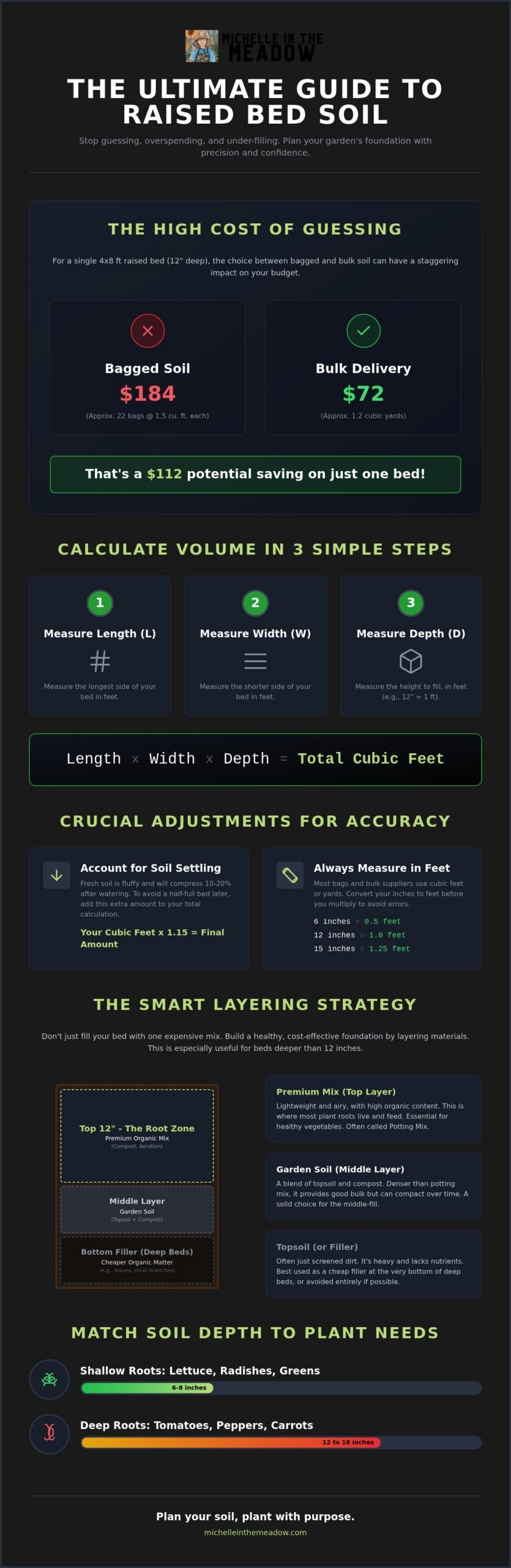
Did you know that filling a single 4×8 foot raised bed with bagged soil can cost you $112 more than ordering the same volume in bulk? It’s a staggering difference that catches many gardeners off guard, especially when you’re staring at a row of empty beds and a shrinking budget. If you’ve ever felt that wave of panic at the garden center, wondering if you need twenty bags or fifty, you’re not alone. I’ve been there, standing in the aisle with a phone in one hand, trying to remember if a cubic yard is 9 or 27 cubic feet. That’s why I created a dedicated soil calculator for raised beds to take the guesswork out of your planning.
It’s frustrating to realize you’ve overspent on dirt, or worse, to run out halfway through the job. You want a garden that thrives from day one without draining your bank account. In this guide, I’ll show you exactly how to calculate your soil needs down to the last inch. We’ll explore the real costs of bulk versus bagged materials, walk through my favorite organic soil recipes, and look at clever ways to fill deep beds for less. By the end, you’ll have a precise shopping list and the confidence to build a healthy, living foundation for your plants.
Key Takeaways
- Master the simple “L x W x D” formula to accurately find your garden’s total cubic feet and avoid the frustration of a half-filled bed.
- Discover when bulk soil delivery provides better value than bags and how to weigh the trade-offs between cost and material quality.
- Use our custom-built soil calculator for raised beds to instantly transform your measurements into a precise, ready-to-use shopping list.
- Learn why a balanced organic mix of compost and aeration materials is far superior to using heavy, compacted topsoil alone.
- Factor in natural soil settling rates to ensure your beds stay at the perfect height for healthy plant roots throughout the growing season.
The Hidden Cost of Guessing: Why Soil Volume Accuracy Matters
Most of us have been there. You buy what looks like a mountain of bags, yet your beautiful new Birdies bed is barely a third full. This “half-full bed” problem isn’t just a minor annoyance; it’s a momentum killer. When you underestimate, you’re stuck with shallow roots and stunted growth. Conversely, overbuying creates a different headache for suburban gardeners. Where do you put three leftover cubic yards of dirt when your garage is already full? Using a soil calculator for raised beds prevents these logistical nightmares. It’s about finding that sweet spot where every dollar spent ends up growing food, not sitting in a pile under a tarp. Accurate planning ensures your plants have the vertical space they need to reach their full potential.
Avoiding the Mid-Planting Hardware Store Run
There’s a specific kind of exhaustion that comes from realizing you’re short on soil just as the sun is setting. You’re covered in dirt, your seedlings are wilting in their nursery pots, and now you have to drive back to the store. Estimating by eye fails because we often forget that volume is three-dimensional. A deep 15-inch bed requires significantly more material than a standard 6-inch frame. You also need to plan for the settling factor. Freshly fluffed soil will naturally compress by about 10% to 20% after the first few waterings. If you don’t account for this natural drop, your bed will look half-empty within a month. A soil calculator for raised beds helps you buy that extra 10% upfront, saving you a frustrated trip to the store later.
Soil Quality vs. Soil Quantity
Raised-bed gardening offers incredible control over your growing environment, but only if you fill that space wisely. Different plants have different needs. While lettuce might be happy with 6 inches of depth, a tomato plant needs at least 12 to 18 inches for its root system to truly thrive. You aren’t just looking for “dirt.” You’re building a life-support system. Understanding the layers helps you save money without sacrificing plant health.
- Topsoil: This is often screened dirt. It’s good for filling deep gaps but is usually too heavy on its own and lacks the nutrients needed for vegetables.
- Garden Soil: Typically a blend of topsoil and compost. It’s a step up but can still compact easily in a raised environment.
- Potting Mix: Lightweight and airy. It’s perfect for drainage and root breathability but can be expensive to use for the entire volume of a deep bed.
By calculating the exact volume first, you can decide how to layer these materials. Maybe you fill the bottom third with a cheaper organic filler and save the premium organic mix for the top 12 inches where the roots actually live. This strategic approach keeps your garden healthy and your wallet full.
How to Calculate Garden Soil Volume Like a Pro
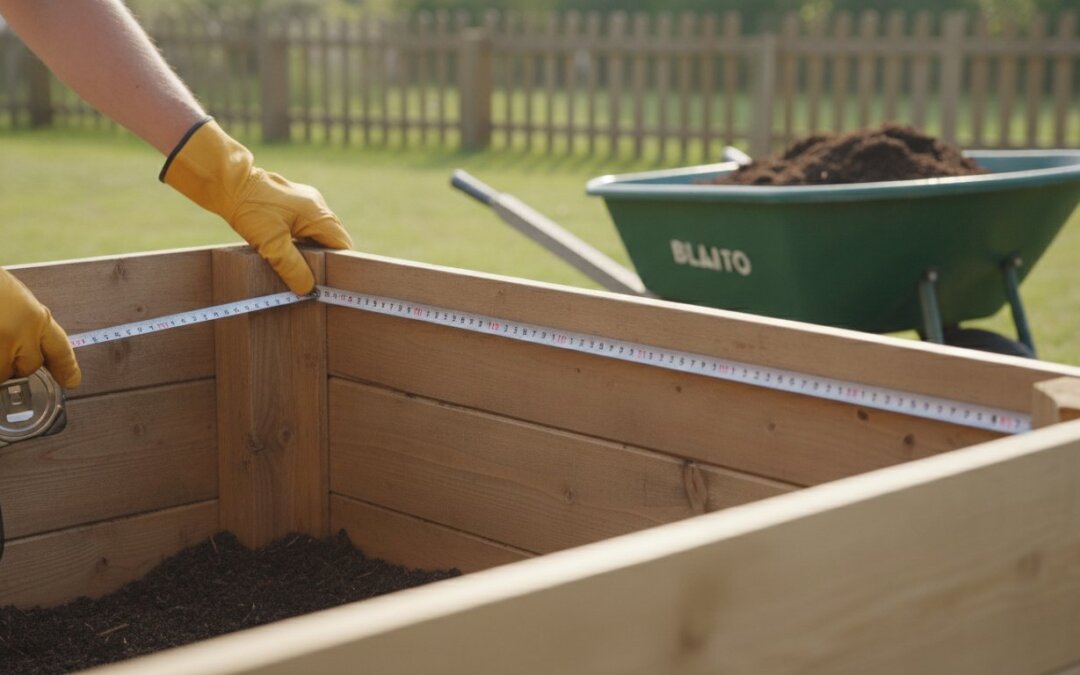
Calculating volume might feel like a middle school math test, but it’s the most important prep work you’ll do before the growing season begins. To get started, you need three numbers: length, width, and depth. Always measure in feet to keep the math simple. If your bed is 12 inches deep, that’s 1 foot; if it’s 6 inches, record that as 0.5 feet. Once you have those dimensions, simply multiply them together (L x W x D) to find your total cubic feet. It’s a straightforward process that forms the foundation of your entire garden budget.
Here is where most people stop, and it’s exactly where they run into trouble. You must account for compression and settling. I always recommend adding a 10% to 15% safety buffer to your final number. Soil is airy when it first comes out of the bag or off the delivery truck, but it settles quickly after the first few heavy rains or watering sessions. If you’re feeling overwhelmed by the conversion steps, using a soil calculator for raised beds can handle these adjustments for you instantly, ensuring you don’t end up with a sunken garden bed by mid-summer.
Calculating for Round or Modular Beds
If you’ve opted for a stylish circular bed or a modular Birdies system, the math changes slightly. For round beds, the formula is Pi (3.14) multiplied by the radius squared, then multiplied by the depth. It sounds complex, but just remember that the radius is half the distance across the middle. For L-shaped or irregular layouts, the easiest trick is to visualize the bed as separate rectangles. Calculate the volume for each “block” and add them together at the end. This prevents you from over-estimating the empty space in the corners of your tiered or stair-step garden designs.
The Cubic Foot vs. Cubic Yard Confusion
Visualizing volume is tough when you’re standing in a quiet garden. To keep it simple: a cubic yard is a unit of volume equal to 27 cubic feet. If you need a mental image, think of a standard household washing machine; that’s roughly one cubic yard. When you’re at the garden center, you’ll likely see bags in sizes like 0.75, 1.5, or 2 cubic feet. If your math tells you that you need 20 cubic feet, and you’re buying 2-cubic-foot bags, you’ll need 10 bags plus two extra for that settling buffer we discussed. Before you head out to buy your supplies, take a moment to double-check your measurements with our tool to ensure your shopping list is perfect. Rounding up to the nearest half-yard or full bag is always safer than being a shovel-full short when you’re tired and ready to plant.
Bulk vs. Bagged: Choosing the Most Cost-Effective Soil Option
Once you’ve run the numbers through our soil calculator for raised beds, the next big decision is how to physically get that material into your garden. It’s a choice between convenience and cost. Buying by the bag is simple; you can throw a few in your trunk and be planting by lunch. However, for larger setups like a series of Birdies modular beds, the cost of those bags adds up faster than you’d think. One cubic yard of soil purchased in bags can cost around $162, whereas bulk soil often ranges between $50 and $120 per cubic yard. Even with a delivery fee, the savings on a large project are hard to ignore.
There’s more to consider than just the price tag. Bagged soil is usually sterilized, which means fewer weed seeds and pathogens. It’s a controlled environment in a plastic wrapper. Bulk soil is a bit of a wild card. You’re getting whatever the local yard has mixed up, which might include hitchhiking weed seeds or debris. Then there’s the “wheelbarrow workout.” A bulk pile in your driveway requires hours of manual labor to move. Plus, there’s the environmental toll; filling ten raised beds with bags creates a mountain of plastic waste that bulk delivery avoids entirely.
When to Choose Bagged Soil
If your project is under 20 cubic feet, stick with bags. They’re the best option for balcony gardens or small urban setups where a dump truck can’t reach. Bagged products also excel when you need specialized environments. If you’re starting seeds or growing picky succulents, the precision of a high-quality bagged mix is worth the premium. It’s also the easiest route for gardeners without a truck or trailer; you don’t have to worry about cleaning soil out of your floor mats for the next six months.
When to Order Bulk Delivery
The tipping point for bulk is usually three or more raised beds. Once your soil calculator for raised beds shows you need more than one cubic yard, bulk delivery becomes the smarter financial move. To ensure you’re getting quality, visit the landscape yard in person. Check for a clean, earthy smell and avoid piles with visible trash or large rocks. If the delivery fee feels steep, try talking to your neighbors. Splitting a single large delivery of organic compost or topsoil can significantly reduce the surcharges for everyone on the block. For deep modular beds, you can also save by ordering a cheaper bulk “filler” for the bottom and reserving the premium organic mix for the top layer.
Filling Your Beds: The Best Organic Soil Mix for Success
Knowing your volume is just the first half of the battle. Once you’ve used the soil calculator for raised beds to get that magic number, you have to decide what actually goes into the frame. If you simply fill a bed with 100% topsoil, you’re setting yourself up for a season of frustration. Standard topsoil is heavy and lacks the pore space necessary for roots to breathe. Over time, it compacts into a dense, brick-like layer that prevents drainage and chokes your plants. To avoid this, we need to build a “living” soil that balances structure, nutrition, and aeration.
The gold standard for many is “Mel’s Mix,” which traditionally uses equal parts compost, vermiculite, and peat moss. Many modern gardeners now choose coconut coir as a sustainable alternative to peat to avoid the environmental impact of peat bog harvesting. This blend is incredibly light and nutrient-dense, which is exactly what heavy feeders like tomatoes and peppers need to thrive. The organic matter provides a steady, slow-release supply of nutrients as it breaks down. It’s an investment in your garden’s long-term health that pays off in higher yields and fewer pest problems.
The 50/50 Raised Bed Recipe
For a more budget-friendly approach that still delivers great results, I often recommend a 50/50 blend. This consists of 50% high-quality screened topsoil for essential mineral structure and 50% well-aged organic compost for nutrition. If your beds are deeper than 12 inches, don’t forget to mix in some perlite or vermiculite. These materials act like tiny sponges; they hold onto moisture while ensuring air can still reach the roots. It’s a simple way to get professional results without buying the most expensive pre-mixed bags on the shelf.
The “Bottom Fill” Secret: Hugelkultur and Lasagna Gardening
If you’re filling deep modular beds like Birdies, you don’t need to fill the entire depth with expensive soil. The bottom 40% of a tall bed can be filled with organic “filler” like untreated logs, sticks, and dried leaves. This is known as Hugelkultur. As these materials slowly decompose, they create a reservoir of moisture and a slow-release fertilizer at the base of your bed. This method can reduce your soil purchase by half, making those deep, back-saving beds much more affordable to start. Once you’ve gathered your logs and sticks, use our soil calculator for raised beds to figure out exactly how much of the premium organic top layer you still need to order.
Use the Michelle In The Meadow Soil Calculator for Instant Results
I’ve spent many afternoons standing in my garden with a tape measure and a dusty notepad, trying to remember if I should multiply by 27 or divide by it. It’s a common struggle that can make the start of a gardening season feel more like a math test than a hobby. That’s exactly why I built the Michelle In The Meadow soil calculator for raised beds. This tool isn’t just a generic volume box; it’s designed to handle the heavy lifting so you can focus on the fun part: picking out your seeds and getting your hands in the dirt. By inputting your specific bed dimensions, you’ll get a tailored shopping list that tells you exactly how many bags to buy or how many cubic yards to order for bulk delivery.
One of the best features of this tool is its ability to help you visualize your potential savings. If you’re using the “bottom fill” method we discussed earlier, you can adjust the depth inputs to see how much premium organic soil you actually need for that top growing layer. It takes the guesswork out of ordering and ensures you don’t end up with a massive pile of leftover dirt sitting on your driveway for the rest of the summer. Once you have your results, you can head to the store with a precise list, knowing you’ve accounted for every inch of your new garden layout.
Why Our Tool is Different
Most online calculators give you a raw volume number and leave it at that. I know from experience that raw volume never tells the whole story. Our soil calculator for raised beds is built with gardeners in mind, which means it automatically factors in those crucial settling rates. It’s also optimized for modern modular systems, such as Birdies beds, which often have unique dimensions compared to traditional wooden frames. Best of all, the interface is completely mobile-friendly. You can pull it up on your phone while you’re standing in the garden center aisle, making it easy to double-check your bag counts before you start loading your cart.
Plan Your Seasonal Garden with Confidence
Getting your soil right is the first major milestone in your seasonal planting schedule. Once your beds are filled with a high-quality organic mix, the rest of the season becomes much more manageable. You won’t be fighting compaction or nutrient deficiencies halfway through the summer. Instead, you’ll have a healthy, aerated foundation that supports strong root growth from day one. Take a moment to measure your beds today so you can start your garden on the right foot. Try the Soil Calculator for Raised Beds now! and get one step closer to your most productive harvest yet.
Ready to Build Your Best Garden Bed Yet?
Getting your hands in the dirt is the best part of gardening, but the prep work is what ensures your success. We’ve seen how accurate volume math prevents the frustration of a half-filled bed and how choosing the right organic mix keeps your plants thriving all season long. Whether you’re filling a single balcony box or a dozen modular Birdies beds, knowing your numbers saves you time, energy, and money. It’s about working smarter so you can spend more time enjoying the harvest and less time running back to the hardware store.
Our soil calculator for raised beds has already helped thousands of home gardeners plan their seasons with confidence. By accounting for natural settling and compression, it’s optimized for sustainable, organic practices and helps users save an average of 15% on soil over-ordering. Don’t leave your garden budget to guesswork this year. Calculate your garden needs with our free Soil Calculator and start your growing season on solid ground. You’ve got this, and I can’t wait to see what you grow!
Frequently Asked Questions
How many bags of soil do I need for a 4×8 raised bed?
A standard 4×8 foot raised garden bed filled to a depth of 12 inches requires approximately 32 cubic feet of material. If you’re buying 2-cubic-foot bags, you’ll need 16 bags to fill the frame completely. However, I always recommend adding two extra bags to account for the natural 10% to 15% settling that occurs after your first deep watering. Using a soil calculator for raised beds helps you get this count right before you head to the store.
Is it cheaper to buy soil in bulk or in bags?
Bulk soil is significantly more cost-effective for any project larger than one cubic yard. While bagged soil offers convenience for small top-offs, buying in bulk can save you over $100 per cubic yard compared to premium bagged mixes. You’ll need to factor in a delivery fee, but for multiple large beds, the savings are undeniable. It’s also a great way to reduce plastic waste while building a healthy foundation for your suburban homestead.
What is the best thing to put at the bottom of a raised garden bed?
The best material for the base depends on your bed depth. For deep modular beds, a layer of untreated logs, branches, and dried leaves is an excellent way to save money on soil while providing long-term nutrients. If your bed is shallow, a layer of plain brown cardboard is perfect for smothering existing grass and weeds. This creates a clean slate for your roots to grow while eventually decomposing into the ground below.
Can I use regular garden soil in a raised bed?
You shouldn’t use 100% regular garden soil or topsoil in a raised bed because it’s too dense for an enclosed environment. In a frame, heavy soil quickly compacts and prevents oxygen from reaching the roots. Instead, you want a lighter organic mix that includes compost and aeration materials like perlite or vermiculite. This ensures your plants have the drainage they need to thrive without the risk of root rot or stunted growth during the season.
How much does soil settle in a new raised bed?
Most new soil mixes will settle between 10% and 20% during the first month of use. This happens as air pockets collapse and organic matter begins to break down. To avoid a “half-full” look by mid-summer, it’s a good idea to overfill your beds slightly at the start. Our soil calculator for raised beds automatically factors in these settling rates so your shopping list includes that necessary extra volume for a perfectly level garden.
Do I need to replace the soil in my raised bed every year?
You don’t need to replace all your soil every year; you just need to refresh it. Each season, your plants use up nutrients and the soil level drops as organic matter decomposes. Simply top off your beds with 2 to 3 inches of fresh organic compost before planting your new seedlings. This replenishes the nutrient bank and improves the soil structure without the back-breaking labor of digging everything out and starting over from scratch.
What is the difference between potting soil and raised bed soil?
Potting soil is a lightweight, soilless medium designed specifically for containers where drainage is the absolute priority. Raised bed soil is typically a heavier blend that includes real topsoil mixed with compost and minerals. While you can use potting soil in a raised bed, it’s often too expensive for large volumes. A dedicated raised bed mix provides the structural support needed for larger vegetable root systems while maintaining better drainage than native ground soil.
How deep should a raised bed be for vegetables?
Most vegetables need at least 6 to 12 inches of soil depth to grow healthy root systems. Leafy greens like spinach are happy with 6 inches, while heavy feeders like tomatoes and carrots prefer 12 to 18 inches. If you’re building on top of hard clay or concrete, aim for a depth of 18 to 24 inches. This ensures your plants have plenty of vertical space to find moisture and nutrients during the peak heat of summer.
