
You’ve spent weeks dreaming of your new garden, but now you’re staring at empty raised beds and a math problem that feels like a headache. Should you buy eighty bags from the store or risk a mountain of loose dirt in your driveway? Most gardeners feel that same spike of anxiety when they realize a single mistake could mean paying for a second delivery or spending $112 more than necessary. That’s exactly why using a garden bed dirt calculator is the secret to a stress-free spring in 2026.
It’s frustrating to choose between the high cost of individual bags and the confusion of cubic yards versus cubic feet. I know how it feels to worry that your soil will settle and leave your plants sinking three inches below the rim. In this guide, you’ll master the dirt math behind your beds so you can order with total confidence. We’ll walk through how to create a precise order list for your local soil yard, how to account for natural settling, and how to build a cost-effective plan for high-quality organic soil.
Key Takeaways
- Save money and avoid the headache of double delivery fees by mastering the “dirt math” required to order the exact amount of soil you need.
- Learn why measuring the internal dimensions of your beds is the only way to get an accurate volume calculation before you place an order.
- Discover the 1-cubic-yard threshold that helps you decide when to buy in bulk and when to stick with bagged soil for your project.
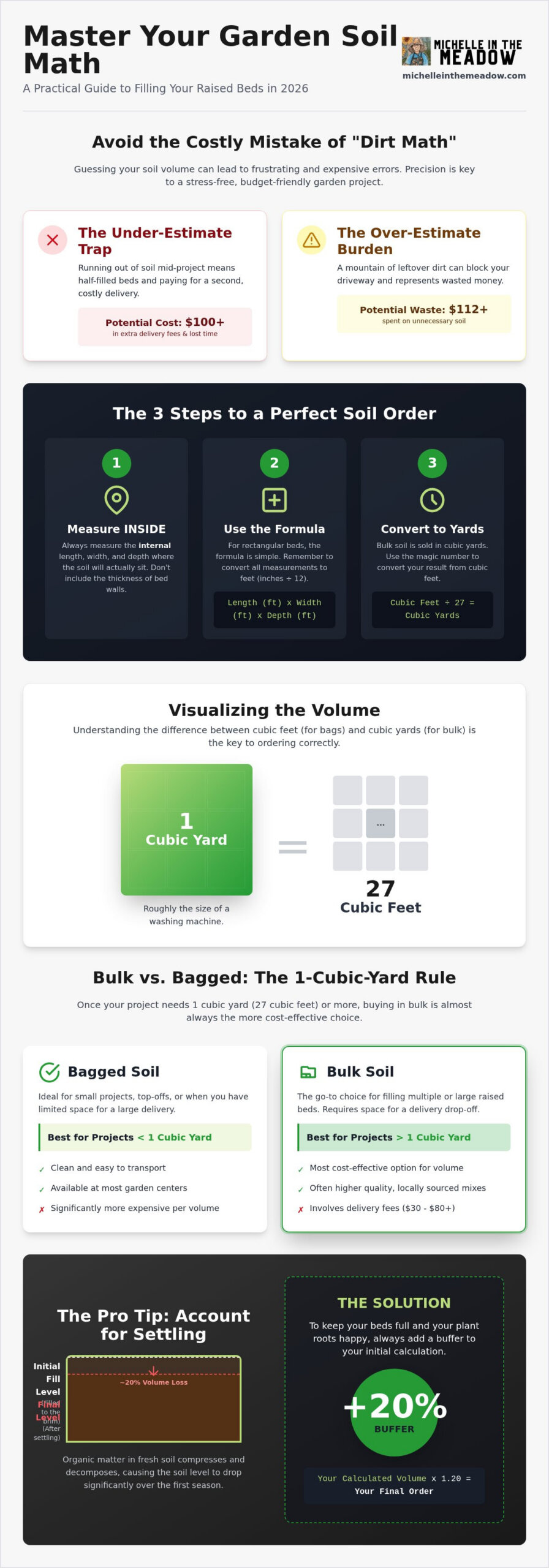
- Account for the natural settling of organic matter by adding a 20% buffer to your order, ensuring your beds stay full all season long.
- Use our interactive garden bed dirt calculator to instantly convert your measurements into a precise shopping list for your local soil yard.
Why Accuracy Matters: Avoiding the Costly Mistake of “Dirt Math”
We’ve all been there. You’re standing in the middle of your yard, tape measure in hand, trying to visualize how much space a pile of soil actually takes up. It’s not just a math problem; it’s a logistical puzzle that can quickly drain your garden budget. Guessing your soil volume is a recipe for frustration. If you under-estimate, you’re stuck with half-filled beds and a second delivery fee. If you over-estimate, you have a mountain of dirt blocking your driveway that you now have to find a home for. Using a garden bed dirt calculator takes the guesswork out of the equation before you ever pick up the phone to call the soil yard.
Raised-bed gardening offers incredible benefits for drainage and soil control, but it requires a significant upfront investment in growing media. Most gardeners feel a spike of anxiety here because volume is much harder to guess than it looks. A bed might look small, but it can swallow twenty bags of soil without breaking a sweat. When you’re working in a suburban space, you don’t have the luxury of “guessing.” You need to know exactly how much space you’re filling so you don’t end up with wasted resources or a project that stalls out halfway through.
Cubic Feet vs. Cubic Yards: A Quick Primer
Most of us are used to buying bags, which are measured in cubic feet. Usually, you’ll find these bags in 1.5 or 2 cubic foot sizes at the local garden center. However, when you order in bulk, the language shifts to cubic yards. Here is the magic number to remember: 27. There are exactly 27 cubic feet in one cubic yard. To visualize it, think of a standard household washing machine. That’s roughly the volume of one cubic yard. If you have several large beds to fill, you aren’t just buying a few bags; you’re moving multiple “washing machines” worth of material. Understanding this conversion is the first step to avoiding a major ordering error.
The Financial Impact of Precision
The math gets real when you look at the receipt. In 2026, bulk topsoil typically costs between $68 and $170 per cubic yard, depending on the quality of the mix. While this is often much cheaper than buying 27 individual bags, the delivery fee is the wildcard. Most yards charge between $30 and $80 just to drop the pile off. If you’re off by even 10%, you might find yourself short by just enough to require a second trip. That mistake can easily cost you an extra $100 or more in combined delivery fees and lost time. Precision is the first step in organic budgeting because it ensures every dollar goes into the ground. Using a garden bed dirt calculator ensures your project stays on track and your driveway stays clear.
How to Calculate Garden Soil Volume: The Essential Formulas
Calculating soil volume doesn’t have to feel like a high school algebra test. It’s really just about understanding the three-dimensional space your plants will call home. Before you pick up the phone to order a delivery, you need a solid number. The most common mistake I see is gardeners measuring the outside of their beds. If you have thick cedar planks or heavy-duty metal walls, those inches add up. Always measure the internal dimensions where the dirt will actually sit. This ensures you aren’t paying for soil that has nowhere to go.
Once you have your measurements in inches, you’ll need to convert them to feet to make the math work. Simply divide your inch measurements by 12. For example, a 10-inch deep bed is 0.83 feet deep. Keeping your units consistent is the only way to get an accurate result from a garden bed dirt calculator. If you want to skip the manual math and get straight to the planting, our interactive garden bed dirt calculator handles these conversions for you instantly.
Calculating Rectangular and Square Beds
For standard beds, the formula is straightforward: Length x Width x Depth. Let’s look at a standard 4×8 foot raised bed. If you plan to fill it to a depth of 10 inches (0.83 feet), the math looks like this: 4 x 8 x 0.83 = 26.56 cubic feet. Since we know there are 27 cubic feet in a yard, this project requires almost exactly one cubic yard of material. If you only plan to fill the bed halfway because you’re using the “hugelkultur” method with logs at the bottom, remember to only calculate the depth of the soil layer itself.
Calculating Circular and Modular Garden Beds
Circular beds or modular metal kits like Birdies beds require a slightly different approach. For a round bed, you’ll use the formula: 3.14 (Pi) x Radius squared x Depth. The radius is simply half the distance across the center of the circle. If your bed is an oval or “oblong” shape, treat it as a rectangle with two half-circles on the ends. Calculate the central rectangular area first, then add the volume of the circular ends together. High-quality Soil for Raised Beds is an investment, so taking these extra few minutes to measure irregular shapes prevents expensive waste. For tiered or multi-level setups, calculate each level as a separate box and add the totals together at the end. Once you have your total cubic feet, divide by 27 to find how many cubic yards to tell the soil yard.
Bulk vs. Bagged: Choosing the Best Way to Fill Your Beds
Deciding between bulk delivery and individual bags is usually a matter of volume and budget. If you’re just topping off a few pots on a balcony, bags are the clear winner for convenience. But for a series of new raised beds, the price difference is staggering. Research from 2026 shows that filling a 1 cubic meter bed with bulk topsoil costs approximately $150 to $250 including delivery. Filling that same space with premium bagged mix can skyrocket to $800. If your garden bed dirt calculator result shows anything over 14 cubic feet, which is about nine large bags, bulk ordering becomes the more cost-effective path.
Beyond the money, we have to consider the environmental footprint. Ordering one cubic yard in bags means hauling, cutting, and disposing of 27 heavy plastic bags. Bulk soil arrives as a loose pile in your driveway, which is much kinder to the planet. However, bulk soil requires more detective work. While big-box bags offer a standardized (if expensive) product, a local “landscape mix” can vary wildly in quality. You have to be your own advocate to ensure you aren’t just buying “cheap dirt” that will struggle to support a thriving vegetable garden.
The Bulk Order Checklist
When you call a local soil yard, don’t just ask for the price. Ask about their screening process. You want soil that has been passed through a 1/2-inch or 3/4-inch screen to remove large rocks and debris. Inquire about their “weed-free” guarantees; reputable yards compost their organic matter at high enough temperatures to kill off invasive seeds. Finally, ask about their delivery minimums. Many yards have a 1 or 2-yard minimum for delivery, so it’s helpful to coordinate with a neighbor if your garden bed dirt calculator shows you only need a smaller amount.
The Hybrid Filling Method
You don’t always have to choose one or the other. I often recommend a “best of both worlds” approach to filling raised beds on a budget. Use a more affordable bulk topsoil for the bottom two-thirds of your beds. For the top six inches where your seedlings’ roots will spend their first few weeks, mix in high-quality bagged organic compost or specialized amendments. This ensures your plants have the best start without the high cost of filling the entire bed with “premium” bagged mix. You can also use the Hugelkultur shortcut by layering old logs and branches at the bottom of very deep beds. This reduces the total volume of soil you need to buy while providing a slow-release source of nutrients for years to come.
The “Settling” Factor: Why You Need 20% More Dirt Than You Think
Most gardeners make the mistake of assuming soil volume is static. It isn’t. When that bulk truck pulls away, your soil is at its fluffiest. It’s full of tiny air pockets. As soon as you hit it with a hose or the first spring rain arrives, gravity and water do their work. This is the “First Drench” effect. Those air pockets collapse; the particles knit together, and suddenly your beautifully filled bed is sitting three inches below the rim. This is why I always advocate for adding a 10 to 20% buffer to your final number from the garden bed dirt calculator.
The composition of your soil also dictates how much it will shrink. If your mix has a high percentage of compost, it will settle even faster. Organic matter is light and porous. Over time, it doesn’t just compact; it actually decomposes and disappears into the ecosystem. Mineral soil components like sand or clay stay put a bit better, but a good 70/30 raised bed mix will still see significant shrinkage in the first month. Planning for this natural compaction is the difference between a professional-looking garden and one that looks half-empty by June.
Managing Soil Levels Over Time
Don’t be afraid to fill your beds right to the very rim during the initial setup. Within a few weeks, that level will drop to a much more manageable height. To keep your soil healthy and prevent further erosion or compaction, apply a thick layer of organic mulch after planting. You should also expect to top off your beds with an inch or two of fresh compost every spring to replace the volume lost to decomposition. This annual “recharge” keeps the soil level consistent and provides fresh nutrients for your plants.
Logistics: Preparing for the Big Dump
Once you’ve used the Michelle In The Meadow Soil Calculator to find your total volume, it’s time to prep the driveway. Use a heavy duty tarp to mark exactly where you want the pile. This protects your driveway from staining and makes the final cleanup much easier. Look up before the truck arrives. Low hanging branches or power lines can prevent a dump truck from safely lifting its bed. You’ll also want a sturdy wheelbarrow and a flat head shovel ready to go. Moving a cubic yard of dirt is a workout, but having the right tools makes the job much faster. Before the truck arrives, place orange cones or a heavy bucket to show the driver exactly where to drop the load.
Using the Michelle In The Meadow Soil Calculator for Perfect Results
Planning a garden should be the fun part of your spring, not a source of math-induced stress. We designed the garden bed dirt calculator to be your digital companion, taking the heavy lifting out of the planning phase. Whether you’re setting up a single rectangular bed or a complex arrangement of modular kits, this tool ensures you aren’t left with a half-empty bed or a surplus pile that kills your lawn. It bridges the gap between your tape measure and the soil yard’s delivery truck, giving you a number you can actually trust.
The interface is simple and intuitive. You can input your measurements in inches, which is how most of us measure our frames, and the tool will instantly output the total in cubic yards. This is crucial because converting 10 inches of depth into a decimal of a foot is where most manual mistakes happen. The calculator also features specific modes for circular and oval beds. This is a lifesaver if you’re using modern metal modular kits that don’t fit into a standard “length times width” box. In 2026, efficiency is the name of the game, and getting your volume right the first time is the ultimate efficiency hack.
Trusting the Tool
I built this tool because I’ve been in your shoes, staring at a pile of dirt and realizing I was four bags short of a finished project. Since we launched it, we’ve helped thousands of gardeners avoid that extra Sunday trip to the home improvement center. One of our readers recently shared that they saved exactly $112 on their project by using the garden bed dirt calculator to justify a bulk order instead of buying individual bags. That’s money that can go back into buying high-quality seeds or a new pair of pruning shears. You can Try our Soil Calculator for Raised Beds here to get your own precise number.
Beyond the Dirt: Amendments and Prep
Once your soil arrives, your job isn’t quite finished. Bulk soil is a fantastic base, but it can sometimes be a bit “lean” on the nutrients your vegetables crave. I always recommend mixing in some high-quality organic amendments to kickstart your ecosystem. Think of bulk soil as the bread and amendments as the butter. Adding worm castings or a well-balanced organic fertilizer ensures your new plants have everything they need from day one. If you’re wondering what else you’ll need for the big day, Check out our favorite gardening tools for filling beds.
With your soil ordered and your beds prepped, you’re ready for the most rewarding part: the seeds. Once the dirt is in place, head over to our seasonal planting guides to see what should go in the ground next. We’re here to walk with you through every stage of the growing season, from the first shovelful of dirt to the final harvest. Let’s get growing together.
Ready to Fill Your Garden with Confidence?
Mastering the math behind your soil order is the first step toward a thriving, cost-effective harvest. You now know that measuring internal dimensions and accounting for that 20% settling factor ensures your beds stay full and healthy all season. By choosing the right bulk mix and avoiding the high markup of individual bags, you’re setting your garden up for long-term success without wasting a single cent.
We want to make this process as simple as possible for you. Our garden bed dirt calculator is designed specifically for the unique dimensions of raised beds and modular kits. It’s used by thousands of home gardeners annually to plan their spring projects with total precision. Beyond just numbers, the tool also includes helpful organic mix recommendations to ensure your soil is as nutrient-dense as possible from the very first day.
Calculate your garden soil needs with our free tool and take the guesswork out of your delivery. Your plants are waiting for their new home; we can’t wait to see what you grow this year.
Frequently Asked Questions
How many bags of soil are in a cubic yard?
There are exactly 27 cubic feet in one cubic yard. If you’re buying standard 1-cubic-foot bags, you’ll need 27 of them to equal a single bulk yard. If you find larger 1.5-cubic-foot bags, that number drops to 18 bags. For the heavy 2-cubic-foot bags often found at home improvement centers, you’ll only need 13.5 bags. It’s always a good idea to check your bag size before you start loading your cart to avoid a second trip.
Is it cheaper to buy soil in bulk or by the bag?
Bulk is almost always the more affordable option for larger projects. One cubic yard of bulk soil mix can be about $112 cheaper than buying the equivalent 27 bags of 1-cubic-foot soil. While bulk delivery involves a flat fee, usually between $30 and $80, the savings on the material itself make it the better choice for any project requiring more than 14 cubic feet of dirt. It’s a much more resource-efficient way to garden.
How deep should a raised garden bed be for vegetables?
Most vegetables thrive in a bed that is 8 to 12 inches deep. This provides enough room for the roots of leafy greens and herbs to spread out comfortably. If you plan on growing deep-rooted crops like carrots, parsnips, or large tomatoes, you might want to aim for 18 to 24 inches. Deeper beds are also a great choice if you have back issues, as they require less bending while you work in the garden.
What is the best soil mix for a raised garden bed?
A reliable 70/30 rule is the gold standard for most home gardens. This mix consists of 70% high-quality topsoil for structure and 30% organic compost for nutrients and moisture retention. You can use our garden bed dirt calculator to find your total volume, then split that number into these two categories. This balance ensures your plants have a stable base that won’t compact too tightly over the growing season, even after heavy rains.
Do I need to put anything at the bottom of my raised bed before the dirt?
I always recommend laying down a layer of plain, brown cardboard or several sheets of newspaper at the bottom. This acts as a natural weed barrier that eventually decomposes into the soil. If you have a very deep bed, you can also use the Hugelkultur method. By placing old logs and branches at the bottom, you fill space for free and provide a slow-release nutrient source for your plants as the wood breaks down over time.
How do I calculate soil for a round or circular garden bed?
To find the volume of a round bed, you’ll need to use the formula for a cylinder. Multiply 3.14 (Pi) by the radius squared, then multiply that by the depth. The radius is just half the distance across the middle of your bed. If math isn’t your favorite hobby, our garden bed dirt calculator has a specific setting for circular shapes. It handles all the complex geometry so you can focus on your planting schedule instead.
Will a cubic yard of dirt fit in my pickup truck?
A standard full-size pickup truck can usually hold one cubic yard of soil, but you have to be careful about the weight. Dry soil is heavy, and wet soil is even heavier. A single cubic yard can weigh between 2,000 and 3,000 pounds. Most half-ton trucks are better off taking a half-yard at a time to avoid damaging the suspension. Always check your vehicle’s payload capacity before you let the loader operator fill the truck bed.
How often do I need to add new soil to my raised beds?
You should plan to add a little fresh material every single spring. Soil is a living ecosystem, and the organic matter in your beds will naturally decompose and settle over time. Adding one to two inches of high-quality compost each year is usually enough to recharge the nutrients and bring the soil level back up to the rim. This annual top-off keeps your garden productive without requiring a full and expensive soil replacement.